

Concrete Calculator
Need concrete for a slab, footing, or stairs? Use our free Concrete Calculator to accurately estimate volume, yards, and bags of mix needed for your project.
Input Data
| Concrete | |
|---|---|
| Cubic Meters | 120 m³ |
| Cubic Yards | 156.954074 yd³ |
| Cubic Feet | 4237.76001 ft³ |
| Cost | $ |
There was an error with your calculation.
How to Estimate the Concrete Volume and Bags Your Project Needs
Last updated: July 21, 2026
Table of Contents
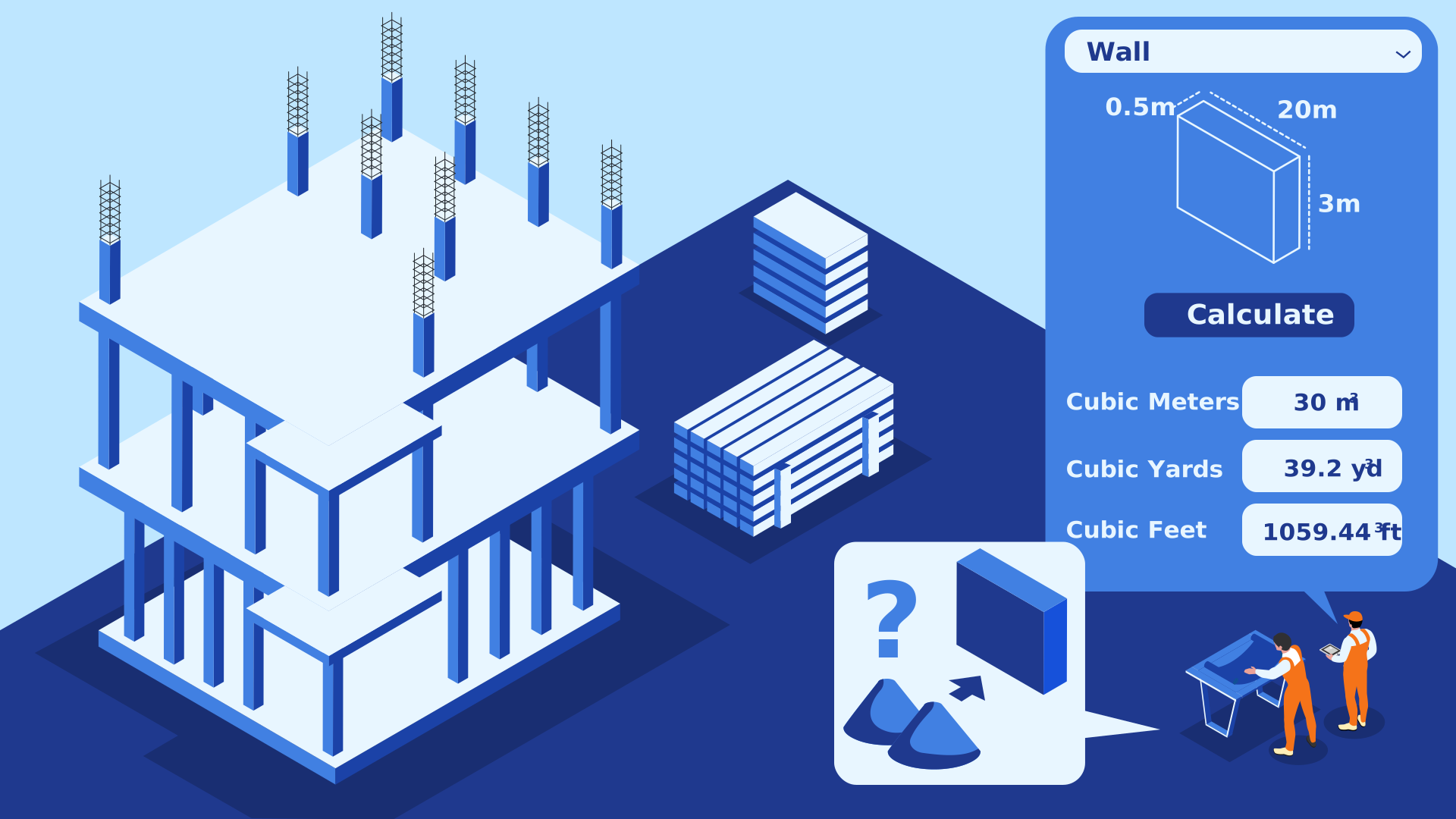
Concrete is neither cheap nor light. Whether you are tackling a DIY home improvement project or managing a professional job site, knowing exactly how much material to purchase is critical. Returning heavy 80-pound bags of concrete is back-breaking work, and over-ordering from a ready-mix concrete delivery service can lead to shocking budget overruns.
Figuring out precisely how much concrete your project requires can be tricky. While standard bags list square footage coverage, that metric alone doesn’t account for depth or complex site dimensions. This is especially true for odd-shaped pours where guessing is a recipe for disaster.
Fortunately, a reliable concrete volume calculator takes the guesswork out of the equation and does all the heavy number crunching for you.
What to Look for in a Concrete Calculator
The first step to a successful pour is finding a powerful, comprehensive concrete calculator.
Make sure your chosen tool goes beyond basic length × width × height volume calculations for simple concrete slabs or walls. Estimating concrete for round footings (piers), circular slabs, tubes, curbs, gutter barriers, and stairs can get complicated quickly. Even for standard slabs, you need to know more than just the total cubic footage. A high-quality concrete estimation tool will instantly calculate and output:
- Cubic feet
- Cubic yards
- Cubic meters
- Weight needed
- The number of 60-lb. bags
- The number of 80-lb. bags
Why Are These Concrete Measurements Important?
Cubic Feet
Small home improvement and DIY concrete projects are often measured in cubic feet. When purchasing bagged concrete mix at a local building supply store, staff and contractors typically use cubic feet as the standard metric for smaller jobs.
Cubic Yards
If you are ordering ready-mix from a concrete delivery service, you need to know your volume in cubic yards. Large mixing trucks exclusively measure loads in cubic yards. Having both cubic feet and cubic yards handy prevents costly miscommunications with contractors who might switch between the two.
While most concrete delivery companies are highly reputable, walking into the transaction with a precise estimate from a concrete calculator ensures you are only paying for exactly what you need. It always pays to be informed.
Cubic Meters
For international projects or contractors using the metric system, calculating concrete in cubic meters is an essential alternative to cubic yards.
Weight Needed
Total weight is a crucial metric, especially for the DIYer planning to haul bags in a personal vehicle. Cars, SUVs, and even heavy-duty pickup trucks have strict payload capacities. Overloading your vehicle with heavy concrete bags risks severe damage to your suspension, transmission, and tires.
Furthermore, seeing the total weight upfront might convince you to skip the heavy lifting and opt for professional delivery instead.
Number of 60-lb. bags / Number of 80-lb. bags
This is where a dedicated concrete bag calculator truly shines. If you’re setting fence posts or pouring a small patio, you likely won't order a mixing truck. Instead, you'll buy individual bags of premixed concrete.
Relying on a ballpark guess leaves you vulnerable to under- or over-buying. Buying too many means hauling heavy bags back to the store and waiting in line when you're already exhausted. Buying too few risks a last-minute panic run to the hardware store, or worse, halting a mid-pour and compromising the structural integrity of your concrete.
Knowing exactly how many 60-lb. and 80-lb. bags you need saves time, money, and your back. Having both bag counts is also highly useful if your local hardware store is sold out of a specific size.
A Practical Example: Calculating Concrete for a Deck
To understand the true value of a concrete calculator, let’s look at a real-world DIY scenario: building a deck.
Suppose this deck requires 12 footings. Each footing must be 12 inches across and two feet deep to sit properly below the frost line. A rough mental estimate might suggest buying 24 60-lb. bags of concrete (assuming two bags per hole). You head to the hardware store and load 24 bags into your minivan.
Now, let's run those exact dimensions through the “Hole, Column, or Round Footings” feature of our concrete calculator:
Diameter (d) is 12 inches (ensuring we use inches, not feet or yards). Depth or Height (h) is 2 feet. Quantity is 12 for the number of footings.
Results:
- 18.85 cubic feet
- 2,507 lbs
- 42 60-lb bags
- 32 80-lb bags
Here’s what taking 60 seconds to use a concrete calculator taught us:
- We drastically underestimated the material needed. Without calculating the exact volume, we would have run out of concrete just 2/3 of the way through the pour.
- Concrete is exceptionally heavy. At over 2,500 lbs, we are well beyond the safe carrying capacity of a standard minivan. Knowing this, we can plan for three separate trips to save our vehicle's suspension and our backs.
- Using 60-lb. bags means 42 trips from the store to the vehicle, and from the vehicle to the backyard. Upgrading to 32 80-lb. bags reduces the amount of loading and unloading required, provided we have the strength to manage the heavier bags.
Recommended Use-Cases for a Concrete Calculator
The further you move away from a basic, rectangular concrete slab, the more a high-quality estimating tool pays off. Simply put: the more complex the shape, the more essential a concrete volume calculator becomes.
Footings. Good deck and structural building practices always call for a solid footing at the base, typically poured into cylindrical holes. Simply measure the widest point of the hole to get your diameter (d). Next, measure from the top edge to the deepest point for your depth or height (h). Assuming all holes are uniform, enter the total quantity. Plug these three numbers into the calculator for a complete volume estimate.
Circular Slabs or Tubes. The measuring protocol for circular slabs is similar to footings, with one added step for hollow tubes. Measure the widest part of the circle for the outer diameter (d1). Then, measure across the inner empty space to get the inner diameter (d2). Enter these alongside your height to let the calculator determine the exact concrete volume required.
Curb and Gutter Barriers. While curbs represent a more complicated shape, knowing exactly what to measure simplifies the process. Just find the curb depth, gutter width, curb height, flag thickness, and total length, and the calculator will handle the complex geometry.
Stairs. Estimating concrete volume for stairs manually is notoriously difficult. The combination of the landing area, the pitch of the risers, and the overall width makes the math highly complex. A dedicated concrete stair calculator makes short work of this problem. Just measure the number of steps, platform depth, width, rise, and run.
Helpful Hints for a Worry-Free Concrete Pour
Now that you know exactly how much concrete to purchase, keep these valuable best practices in mind to ensure your project runs smoothly.
The Correct Amount of Water
When adding water to your dry mix, always do so in stages. Add a small amount, mix thoroughly, test, and repeat. Continue this process until the concrete achieves the consistency of thick oatmeal. A great field test is to pick up a handful (while wearing gloves) and mold it into a shape. If it holds its form, it's ready. If it leaks through your fingers, it’s too wet.
Concrete should never be runny. A watery mix compromises structural integrity, leading to weak, cracked, and highly porous surfaces that deteriorate quickly. If you accidentally over-water the mix, simply add more dry concrete and remix.
Concrete Curing Times
While ambient temperature and humidity heavily affect concrete curing times, there are general guidelines every DIYer should follow:
24 to 48 Hours: At this stage, you can safely remove the concrete forms, and the surface is generally ready for light foot traffic. The mix is officially considered "dry."
7 Days: The concrete is now "partially cured." It has reached a significant portion of its total strength and can typically handle the weight of cars, trucks, and heavy machinery without cracking.
28 Days: The concrete is fully "cured." It has reached its maximum engineered strength and is ready for a lifetime of heavy use.