

Tax Calculator
Estimate your federal income tax, find valuable deductions, and calculate your refund with our free Tax Calculator. Simplify your tax return process today!
Input Data
| Tax | |
|---|---|
| Taxable Income | $58,900.00 |
| Federal Income Tax | $7,670.00 |
| Effective Tax Rate | 10.23% |
| Marginal Tax Bracket | 22% |
| Income After Tax | $67,330.00 |
There was an error with your calculation.
Understanding Tax Brackets, Deductions, and Credits on Your Return
Last updated: July 21, 2026
Table of Contents
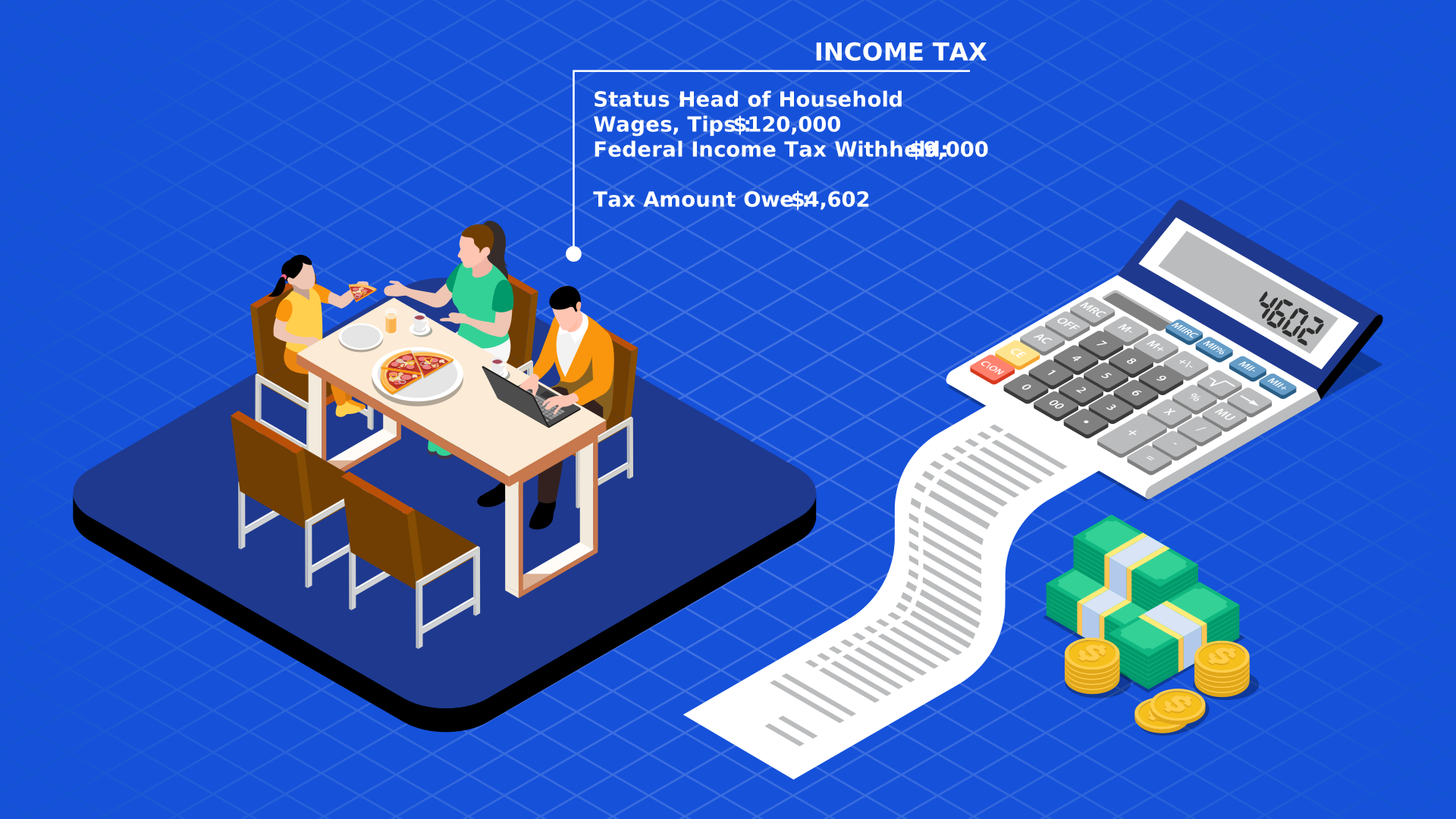
If you earn any type of income, chances are you will need to file a tax return. With a tax code containing thousands of complex rules, accurately calculating your tax liability can feel overwhelming. Fortunately, an online income tax calculator can quickly handle the most complicated math for you, serving as a reliable tax refund estimator.
However, before you start crunching numbers, it helps to understand the basics of taxation, including key terms like tax brackets, credits, and deductions. Below, we explore how a tax calculator works and break down essential tax terminology.
Understanding Taxes
Before using a tax bracket calculator, it is important to grasp the fundamentals. At its core, a tax is a mandatory contribution levied by a government entity. These funds are used to pay down government debt or to finance essential public services and infrastructure.
Almost all forms of income are subject to taxation, including standard wages, capital gains, royalties, and dividends. Depending on your primary residence, you may be responsible for federal income tax, state tax, and even local or city taxes.
Taxable income
Now that you know how taxation works, you need to determine what qualifies as taxable income. Notably, not all earnings are taxed equally. For instance, if your total income falls below a certain threshold, you may owe nothing at all. However, once your earnings exceed these baseline exemptions, you will have to pay taxes on the income that surpasses the 0% tax bracket.
In most tax systems, including the United States, revenue and profits are assessed using a progressive tax structure. This means that as your income increases, the portions of your earnings that exceed certain thresholds are taxed at progressively higher rates.
Suppose you earn $100,000 for the 2026 tax year as a single filer. Under a progressive system, your entire income isn't taxed at a single flat rate. Instead, income up to $12,400 is taxed at the lowest bracket, while only the portion of your earnings exceeding $50,400 falls into the higher 22% marginal tax bracket. You can use a free income tax calculator to easily determine what is known as your "effective tax rate" based on your $100,000 salary.
For example, a single filer for the 2026 tax year earning $100,000 in taxable income will typically have an effective tax rate of around 17%. Note that this calculation strictly covers federal income tax and does not include Social Security, Medicare (FICA), or state taxes, which will increase your overall tax liability.
Tax Brackets
Tax brackets define the specific percentage at which different levels of your income are taxed. As highlighted above, a progressive system means that the more you earn, the higher your marginal and effective tax rates become. In the United States, there are multiple federal tax brackets, and the specific rates applied to your earnings depend heavily on your filing status. The primary tax filing statuses include:
- Single filer
- Married, filing jointly
- Married, filing separately
- Head of household
Deductions
Deductions play an essential role in minimizing your overall tax burden. Essentially, a tax deduction reduces your total amount of taxable income, ultimately lowering the taxes you owe. When you or your CPA prepare your tax returns, you must choose whether to claim the standard deduction or itemize your deductions.
Standard deduction
The standard deduction is a fixed, predetermined amount that directly reduces your taxable income. If your financial situation is relatively straightforward, taking the standard deduction is often the best choice. A major benefit of claiming the standard deduction is its simplicity—you do not need to track individual expenses, list numerous claims, or worry about providing a mountain of receipts in the event of an IRS audit.
Itemized deductions
If you have a more complex financial profile, have significant deductible expenses, or operate a business, you should consider itemizing your deductions. Itemized deductions allow you to claim specific qualifying purchases and expenses to lower your taxable income further. While itemizing can potentially allow you to pay less in taxes, it requires meticulous record-keeping, as you must provide valid proof and receipts for every claimed expense.
Tax Credits
It is easy to confuse a tax deduction with a tax credit. While both ultimately reduce your overall tax bill, they function quite differently. Unlike a deduction (which lowers your taxable income), a tax credit is a direct, dollar-for-dollar financial incentive offered by the government that lowers the actual taxes you owe. For instance, the federal clean-vehicle credit once offered up to $7,500 for a qualifying electric vehicle, though under the One Big Beautiful Bill Act this credit was terminated for vehicles acquired after September 30, 2025. Here are several other common examples of valuable tax credits:
Earned income tax credit
The Earned Income Tax Credit (EITC) is designed to help low- to moderate-income working individuals and families reduce their tax burden. To qualify for this refundable tax credit, your earned income and adjusted gross income (AGI) must fall below specific federal thresholds.
American Opportunity tax credit
The American Opportunity Tax Credit (AOTC) assists students pursuing a higher education degree with the costs of tuition and related expenses. To qualify, a student must be enrolled at least half-time for one academic period during the applicable tax year.
Lifetime learning tax credit
The Lifetime Learning Credit (LLC) supports individuals enrolled in eligible educational institutions. Typically, taxpayers who qualify for this credit are taking undergraduate, graduate, or professional degree courses to acquire or improve specialized job skills.
Child and dependent care tax credit
This credit provides financial relief to working parents who incur out-of-pocket expenses for childcare while working or actively seeking employment. Additionally, the credit can be claimed by taxpayers paying for the care of an incapacitated spouse or dependent adult.
Savers tax credit
Officially known as the Retirement Savings Contributions Credit, the Saver's Tax Credit rewards individuals who contribute to qualifying retirement or investment accounts. Eligible accounts include employer-sponsored 401(k) plans, 403(b)s, SIMPLE IRAs, SEP IRAs, Thrift Savings Plans (TSP), and governmental 457 plans.
Understanding Tax Calculators
A highly accurate online tax calculator can make the often stressful filing process far more manageable. Whether you are estimating your potential refund, adjusting your withholdings, or double-checking a tax preparer's work, utilizing a free tax calculator is an invaluable step in optimizing your personal finances and ensuring a seamless tax season.