Auto Loan Calculator
Plan your car purchase with our free Auto Loan Calculator. Easily estimate monthly payments, total interest, sales tax, and trade-in value in seconds.
Input Data
Auto Loan
| Monthly Payment | $447.43 |
|---|---|
| Total Loan Amount | $24,000.00 |
| Sale Tax | $2,100.00 |
| Upfront Payment | $8,400.00 |
| Total of 60 Loan Payments | $26,845.95 |
| Total Loan Interest | $2,845.95 |
| Total Cost (price, interest, tax, fees) | $35,245.95 |
Interest
Principal
| # | BEGINNING BALANCE | INTEREST | PRINCIPAL | ENDING BALANCE |
|---|---|---|---|---|
| 1 | $24,000.00 | $90.00 | $357.43 | $23,642.57 |
| 2 | $23,642.57 | $88.66 | $358.77 | $23,283.79 |
| 3 | $23,283.79 | $87.31 | $360.12 | $22,923.68 |
| 4 | $22,923.68 | $85.96 | $361.47 | $22,562.21 |
| 5 | $22,562.21 | $84.61 | $362.82 | $22,199.38 |
| 6 | $22,199.38 | $83.25 | $364.18 | $21,835.20 |
| 7 | $21,835.20 | $81.88 | $365.55 | $21,469.65 |
| 8 | $21,469.65 | $80.51 | $366.92 | $21,102.73 |
| 9 | $21,102.73 | $79.14 | $368.30 | $20,734.43 |
| 10 | $20,734.43 | $77.75 | $369.68 | $20,364.75 |
| 11 | $20,364.75 | $76.37 | $371.06 | $19,993.69 |
| 12 | $19,993.69 | $74.98 | $372.46 | $19,621.23 |
| Year 1 End | ||||
| 13 | $19,621.23 | $73.58 | $373.85 | $19,247.38 |
| 14 | $19,247.38 | $72.18 | $375.25 | $18,872.12 |
| 15 | $18,872.12 | $70.77 | $376.66 | $18,495.46 |
| 16 | $18,495.46 | $69.36 | $378.07 | $18,117.39 |
| 17 | $18,117.39 | $67.94 | $379.49 | $17,737.89 |
| 18 | $17,737.89 | $66.52 | $380.92 | $17,356.98 |
| 19 | $17,356.98 | $65.09 | $382.34 | $16,974.64 |
| 20 | $16,974.64 | $63.65 | $383.78 | $16,590.86 |
| 21 | $16,590.86 | $62.22 | $385.22 | $16,205.64 |
| 22 | $16,205.64 | $60.77 | $386.66 | $15,818.98 |
| 23 | $15,818.98 | $59.32 | $388.11 | $15,430.87 |
| 24 | $15,430.87 | $57.87 | $389.57 | $15,041.30 |
| Year 2 End | ||||
| 25 | $15,041.30 | $56.40 | $391.03 | $14,650.27 |
| 26 | $14,650.27 | $54.94 | $392.49 | $14,257.78 |
| 27 | $14,257.78 | $53.47 | $393.97 | $13,863.81 |
| 28 | $13,863.81 | $51.99 | $395.44 | $13,468.37 |
| 29 | $13,468.37 | $50.51 | $396.93 | $13,071.45 |
| 30 | $13,071.45 | $49.02 | $398.41 | $12,673.03 |
| 31 | $12,673.03 | $47.52 | $399.91 | $12,273.12 |
| 32 | $12,273.12 | $46.02 | $401.41 | $11,871.71 |
| 33 | $11,871.71 | $44.52 | $402.91 | $11,468.80 |
| 34 | $11,468.80 | $43.01 | $404.42 | $11,064.38 |
| 35 | $11,064.38 | $41.49 | $405.94 | $10,658.43 |
| 36 | $10,658.43 | $39.97 | $407.46 | $10,250.97 |
| Year 3 End | ||||
| 37 | $10,250.97 | $38.44 | $408.99 | $9,841.98 |
| 38 | $9,841.98 | $36.91 | $410.53 | $9,431.45 |
| 39 | $9,431.45 | $35.37 | $412.06 | $9,019.39 |
| 40 | $9,019.39 | $33.82 | $413.61 | $8,605.78 |
| 41 | $8,605.78 | $32.27 | $415.16 | $8,190.62 |
| 42 | $8,190.62 | $30.71 | $416.72 | $7,773.90 |
| 43 | $7,773.90 | $29.15 | $418.28 | $7,355.62 |
| 44 | $7,355.62 | $27.58 | $419.85 | $6,935.77 |
| 45 | $6,935.77 | $26.01 | $421.42 | $6,514.35 |
| 46 | $6,514.35 | $24.43 | $423.00 | $6,091.35 |
| 47 | $6,091.35 | $22.84 | $424.59 | $5,666.76 |
| 48 | $5,666.76 | $21.25 | $426.18 | $5,240.57 |
| Year 4 End | ||||
| 49 | $5,240.57 | $19.65 | $427.78 | $4,812.79 |
| 50 | $4,812.79 | $18.05 | $429.38 | $4,383.41 |
| 51 | $4,383.41 | $16.44 | $430.99 | $3,952.41 |
| 52 | $3,952.41 | $14.82 | $432.61 | $3,519.80 |
| 53 | $3,519.80 | $13.20 | $434.23 | $3,085.57 |
| 54 | $3,085.57 | $11.57 | $435.86 | $2,649.71 |
| 55 | $2,649.71 | $9.94 | $437.50 | $2,212.21 |
| 56 | $2,212.21 | $8.30 | $439.14 | $1,773.08 |
| 57 | $1,773.08 | $6.65 | $440.78 | $1,332.29 |
| 58 | $1,332.29 | $5.00 | $442.44 | $889.86 |
| 59 | $889.86 | $3.34 | $444.10 | $445.76 |
| 60 | $445.76 | $1.67 | $445.76 | $0.00 |
| Year 5 End | ||||
There was an error with your calculation.
A Complete Guide to Auto Loans, Financing, Fees, and Trade-Ins
Last updated: July 21, 2026
Table of Contents
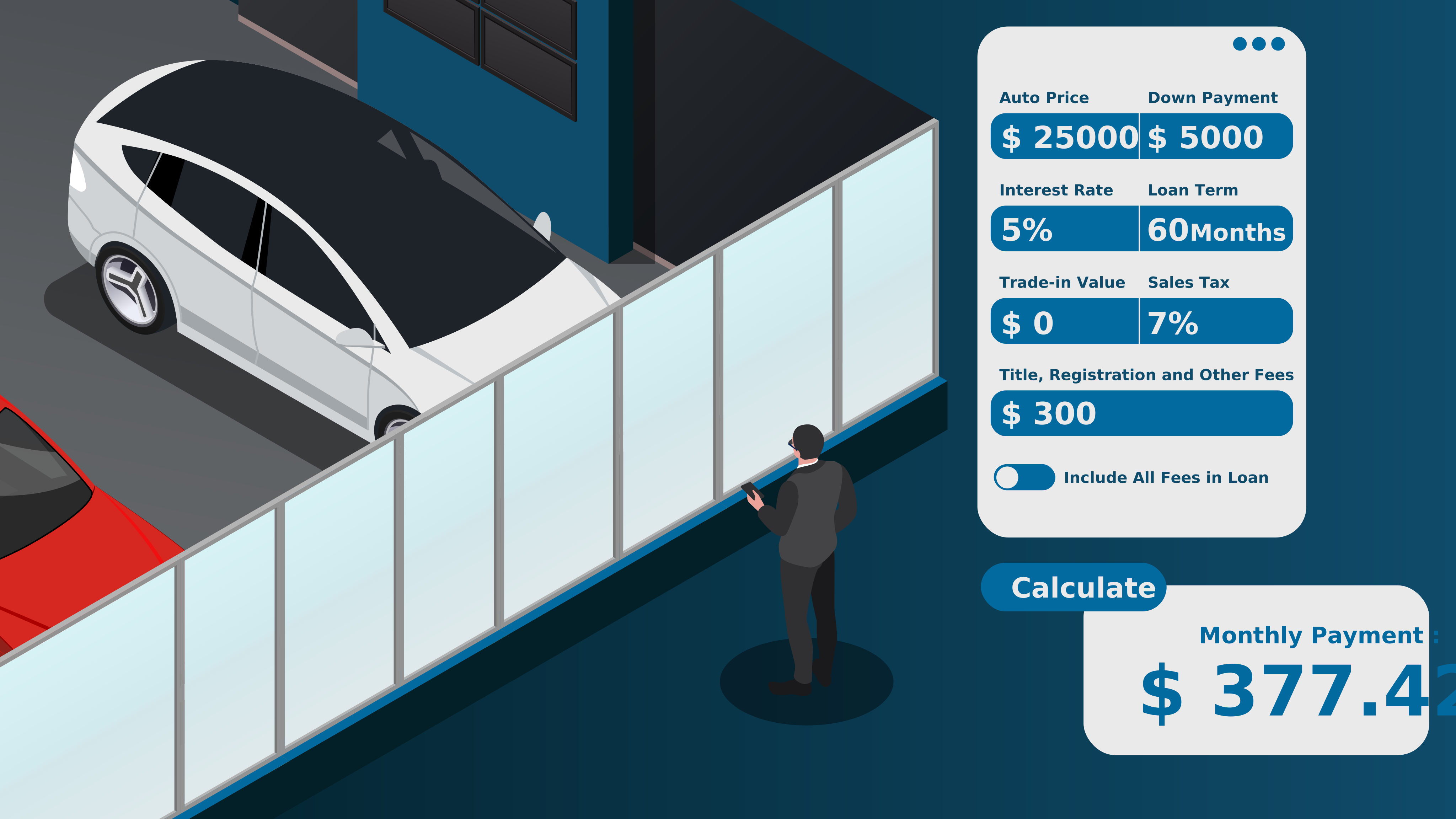
Most people using our Auto Loan Calculator are looking to finance a vehicle purchase within the United States. However, if you are located outside the U.S., you can still use this calculator by making minor adjustments to fit your local currency and tax laws. To determine your maximum affordable car purchase price and other financing details, you can use the Monthly Payments tab to run a reverse auto loan calculation.
Automobile Loans
Purchasing a vehicle usually requires taking out some form of auto financing. Borrowers are obligated to repay the principal and interest to the lender in monthly installments. As with most standard secured bank loans in the U.S., auto loan repayment terms typically span 36, 60, 72, or 84 months. Because the vehicle serves as collateral, the lender can legally repossess the automobile if the borrower defaults on their loan payments.
Direct Lending vs. Dealership Financing
Direct lending and dealership financing are the two most common ways to finance a car. The first option involves securing a traditional loan from a bank, credit union, or online financial institution. Once you negotiate a price with the car dealer, the funds from your direct lender are used to pay for the new vehicle.
Dealership financing works similarly to traditional bank financing, with the key difference being that the dealer handles the loan application and paperwork on your behalf. These auto loans are often processed by captive lenders—financial entities closely associated with specific automobile brands. In many cases, the dealership sells your contract to a bank, credit union, or other financial assignee who ultimately services the debt.
When consumers walk into a dealership with pre-approved financing, they have significantly more leverage to negotiate a better deal. A pre-approved auto loan means buyers aren't entirely reliant on a single dealership's financing terms, giving them the freedom to walk away if the offer isn't right.
While dealer financing offers fewer options for comparison shopping, it remains a convenient choice for buyers who prefer a streamlined process or who may struggle to secure an auto loan directly through a bank.
If you are in the market for a brand-new car, be sure to look into financing options directly from auto manufacturers. Automakers frequently offer highly promotional financing deals to drive dealership sales. It's common to find exceptionally low interest rates through captive lenders, including 0%, 0.9%, 1.9%, and 2.9% APR offers.
Rebates on Vehicles
To incentivize buyers, automakers frequently offer cash rebates on new vehicles. Depending on your state, this cash rebate may or may not be subject to sales tax. For example, on a $30,000 vehicle with a $2,000 rebate, some states calculate the sales tax based on the full $30,000, not the discounted $28,000. Fortunately, in most jurisdictions, cash rebates are not taxed. States that do not tax cash rebates include Alaska, Arizona, Delaware, Iowa, Kansas, Kentucky, Louisiana, Massachusetts, Minnesota, Missouri, Montana, Nebraska, New Hampshire, Oklahoma, Oregon, Pennsylvania, Rhode Island, Texas, Utah, Vermont, and Wyoming.
Generally, these incentives are exclusive to new cars. While certain used-car dealerships might offer cash rebates, it is rare due to the complexity of determining a used vehicle’s exact market value.
Fees
The sticker price isn't the only cost you'll face when buying a car. Buyers with lower credit scores might be required to pay certain fees upfront, while other expenses can either be rolled into the auto loan or paid out-of-pocket at signing. A list of the most common fees associated with buying a car in the U.S. includes:
- Vehicle purchases are subject to state sales tax in the vast majority of the U.S. Depending on the state where you purchase the vehicle, you will need to pay sales tax based on the purchase price. States that do not levy a state sales tax on vehicles include Alaska, Delaware, Montana, New Hampshire, and Oregon.
- Dealers charge a documentation fee (or "doc fee") to cover the administrative costs of processing paperwork, such as the title and registration.
- State-collected charges for legally registering the vehicle in your name are known as title and registration fees.
- Regional dealers pay an advertising fee to promote the manufacturer's vehicles in their local market, and this cost is often passed on to the buyer. This fee is typically a few hundred dollars.
- The destination fee covers the cost of transporting the vehicle from the factory to the dealership lot. This typically ranges between $900 and $1,500.
- A valid driver’s license and comprehensive auto insurance are legally required in the United States to drive on public roads.
Full-coverage car insurance is almost always required by lenders when you finance a vehicle, rather than paying cash. Comprehensive policies can cost upwards of $1,000 per year. To expedite the financing and registration process, many dealerships can provide new buyers with a short-term insurance policy (usually valid for 1 to 2 months).
When using our calculator, ensure you check the box for ‘Include All Fees in Loan’ if you plan to roll these extra costs into your financing. If you are paying these fees upfront in cash, leave this field blank. Always ask the dealership to explain and justify any "strange" or unexpected fees added to your contract.
Strategies for obtaining a car loan
Preparation
The best way to secure a favorable auto loan is to prepare in advance. Calculate your budget and know what you can comfortably afford before stepping foot on a dealership lot. Researching average market prices for the specific make and model you want will give you a baseline for negotiating effectively.
Once you narrow down your choice, it is incredibly helpful to have a few competitive quotes in hand. This means contacting multiple lenders, banks, or credit unions to compare pre-approval rates.
Like any business, auto dealerships want to maximize their profit margins. However, with solid preparation and negotiation, they are often willing to drop the price significantly from their initial offer. Walking in with a pre-approved direct loan is one of the most powerful negotiating tools you can have.
Credit
Auto loan approvals—and the interest rates attached to them—are heavily based on your credit score, and to a lesser extent, your income-to-debt ratio. Borrowers with excellent credit can access the lowest interest rates, substantially reducing the total cost of the vehicle. Taking time to improve your credit score before applying for a loan is one of the best ways to guarantee you get the most affordable terms possible.
Low-Interest Rate vs. Cash Back
When buying a new car, you may be forced to choose between a manufacturer cash rebate and an ultra-low promotional interest rate. There is no universal right answer. Cash back rebates instantly lower the purchase price (and principal loan amount) of the vehicle. Conversely, a reduced interest rate might save you more money over the total life of the loan. Run both scenarios through our Auto Loan Calculator to see which option costs less in the long run.
Pay it off on time
Always review your loan agreement carefully before signing. Shortening your loan term or paying off the principal early can save you a massive amount of money in interest. However, be aware that some lenders include prepayment penalties or strict restrictions on paying off the debt ahead of schedule.
Be open to other possibilities
Buying a pre-owned vehicle, even one that is only a few years old, can save you thousands of dollars compared to buying brand new. New cars suffer from steep initial depreciation—often losing over 10% of their value the moment you drive them off the lot. Avoiding this "off-the-lot depreciation" makes late-model used cars an excellent financial choice.
Alternatively, leasing acts as a long-term rental. It typically requires a lower monthly payment than traditional financing and is a great option for drivers who prefer to upgrade to a new car every few years. Check out our Auto Lease Calculator to run detailed leasing calculations.
As an Alternative, Consider Paying Cash for Your Next Vehicle Purchase
While the vast majority of car buyers in the U.S. rely on auto loans, there are profound financial benefits to paying for your vehicle entirely in cash.
Avoid Making Monthly Payments
Buying a car in cash eliminates the stress of monthly loan payments. The psychological and emotional benefits of living debt-free can be incredibly rewarding for those who don’t want to be tied down to a depreciating asset for years.
Flexibility
When you pay in full, you own the vehicle outright immediately. Without a lienholder, you have the total freedom to sell the car whenever you want, opt for less expensive liability-only insurance, or modify the vehicle to your liking.
Avoid Interest
Paying cash completely eliminates interest charges, significantly lowering your true cost of ownership. For example, if you borrow $32,000 for five years at a 6% interest rate, you will have a monthly payment of $618.65 and pay a total of $5,118.98 in interest. By paying cash upfront, you keep that $5,118.98 in your pocket.
Discounts
Depending on the dealership and the automaker's current promotions, paying cash might unlock exclusive discounts or cash-back rebates that are not available to buyers who use promotional low-interest financing.
Avoid Overbuying
Financing makes expensive cars seem more affordable by breaking the cost down into monthly chunks, often tempting buyers to purchase more cars than they actually need. Paying a single lump sum keeps you strictly within your calculated budget. It’s easy for a dealer to convince you to extend a loan term to afford a pricier trim, but cash buyers are immune to this tactic.
Salespeople use complex financing math to maximize their commissions; paying cash cuts through the confusion and keeps the transaction simple.
Avoid Underwater Loan
Vehicles are depreciating assets. If your car loses value faster than you pay down your loan, you end up "underwater"—meaning you owe the bank more than the car is currently worth. Buying the car in cash completely protects you from negative equity.
While buying a car with cash has many advantages, it isn't necessarily the right move for everyone. Even if you have the savings to buy a vehicle outright, sometimes financing is the smarter financial strategy.
If you qualify for an exceptionally low interest rate, you might be better off taking the loan and investing your cash elsewhere for a higher rate of return. Additionally, consumers actively looking to build or repair their credit history can greatly benefit from making on-time payments on an auto loan.
Trade-in Value
A trade-in involves selling your current vehicle to the dealership and applying that credit toward the purchase of a new car. Dealerships need to turn a profit, so you generally won't get the maximum market value for your trade-in. You can usually secure a better financial return by selling the car privately and applying those funds as a down payment.
However, trading in at a dealership does offer a distinct tax advantage in most states. The state sales tax is only applied to the difference between the new car's price and your trade-in's value.
For example, if you buy a $30,000 new car, trade in your old car for $10,000, and have an 8% state sales tax rate, the tax calculation looks like this:
($30,000 - $10,000) × 8% = $1,600
Be aware that some states—including California, the District of Columbia, Hawaii, Kentucky, Maryland, Michigan, Montana, and Virginia—do not offer this sales tax discount on trade-ins. Our Auto Loan Calculator factors in state-specific tax rules to accurately compute your sales tax based on your trade-in value.
If you purchase that same $30,000 vehicle in a state that does not allow trade-in tax exemptions, your sales tax would be:
$30,000 × 8% = $2,400
That $800 difference in tax savings is an important factor to weigh when deciding whether to trade your car in at the dealership or sell it to a private party.