Calorie Deficit Calculator
Find the exact daily calories for your weight-loss goal. Set a weekly pace or a target date, and see the deficit, the timeline, and whether the plan is safe.
Input Data
Daily Calorie Target
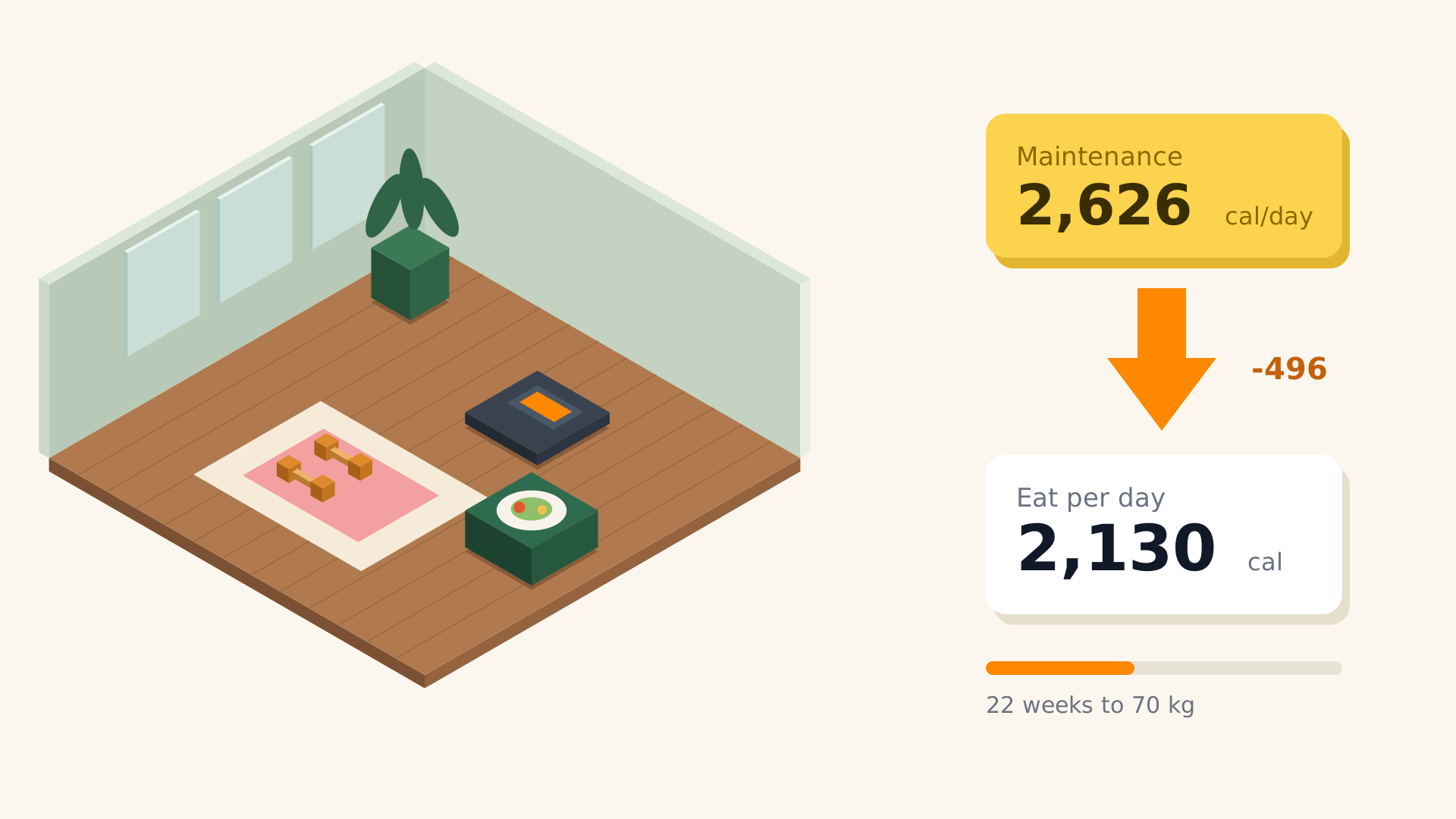
2,130Calories per day
This is a moderate, sustainable deficit.
| Your Deficit Plan | |
|---|---|
| Maintenance Calories (TDEE) | 2,626 cal/day |
| Daily Deficit | 496 cal/day |
| Weekly Deficit | 3,472 cal |
| Weekly Weight Loss | 1 lb |
| Total to Lose | 22 lb |
| Time to Goal | 22 weeks |
| Goal Date | Jun 19, 2026 |
There was an error with your calculation.
How to Set a Calorie Deficit You Can Actually Hold
Last updated: July 28, 2026
Table of Contents
A calorie deficit is the whole of weight loss. Everything else — meal timing, macros, fasting windows, which foods count as "clean" — changes how comfortable the deficit feels, not whether it works. Eat less energy than you spend, and stored fat covers the difference.
The arithmetic is simple enough to do on a napkin. The hard part is picking a deficit you will still be holding in eight weeks, and noticing when the number you picked has quietly become unsafe. That is what this calculator is for: it starts from the goal you actually have, works backwards to the daily number, and tells you when the plan asks too much.
What a Calorie Deficit Actually Is
Your body spends energy all day: keeping your heart beating and your temperature stable, digesting food, fidgeting, walking to the kitchen, training. Add it all up and you get your Total Daily Energy Expenditure (TDEE) — your maintenance level, the intake at which your weight holds steady.
Eat below that line and the shortfall has to come from somewhere. Mostly it comes from stored fat, along with some glycogen, water, and — if the deficit is steep or protein is low — muscle. Eat above it and the surplus is stored.
The conversion everyone quotes is roughly 3,500 calories per pound of body fat (about 7,700 per kilogram), the figure behind every "500 a day is a pound a week" rule of thumb. It is the basis of this calculator's timeline, and it is worth knowing where it bends: it treats your body as a fixed machine, when in reality maintenance falls as you get lighter. A 200-pound person and the 180-pound version of that same person do not burn the same calories doing the same day. This is why a plan that was accurate in week one drifts by week ten, and why re-running the numbers every few weeks matters more than getting them perfect on day one.
How This Calculator Builds Your Plan
It starts with maintenance
First it estimates your BMR — the energy your body burns doing nothing at all — from your sex, age, height, and weight. You can choose the equation under Options: Mifflin-St Jeor (the modern default), Revised Harris-Benedict, or Katch-McArdle, which uses body fat percentage instead and is the better choice if you know that number accurately.
Then it multiplies that by your activity level to get maintenance. Be honest here, and when in doubt, go one notch lower than feels flattering. Activity multipliers are where most calorie plans quietly go wrong: "moderate" describes deliberate training four or five times a week, not a busy schedule.
Then it solves for whatever you did not give it
Most calorie tools hand you a table of paces and let you pick a row. This one takes your goal weight and fills in the missing side of the equation:
- Plan by weekly rate. You say how fast you want to lose — say a pound a week — and it returns the daily intake that produces it, plus the date you arrive at your goal weight.
- Plan by target date. You name the date instead — a wedding, a season, a check-up — and it works out the pace that deadline demands and what it costs you per day.
The second direction is the more useful one, because it makes an unreasonable deadline visible as a number instead of a feeling. Wanting to lose 20 pounds in six weeks sounds ambitious; seeing that it requires eating 1,100 calories a day is a different kind of information.
And then it checks the plan against you
Every result ends with a verdict, and this is the part a bare subtraction leaves out:
- Below the floor. If the plan drops you under roughly 1,500 calories a day for men or 1,200 for women, it says so. Diets below those levels are not automatically dangerous, but they stop being something to run on your own — they belong under medical supervision, because it becomes hard to hit protein, micronutrient, and fibre needs on that little food.
- Too fast. Losing more than about 1% of your body weight per week tilts the composition of the loss: more lean tissue, less fat, and a steeper drop in the metabolic rate you are going to have to live with afterwards.
- Sustainable. A moderate deficit, and the plan is yours to run.
How Big Should the Deficit Be?
For most people the honest answer is: smaller than you want, and for longer than you want.
A deficit of 15–25% below maintenance is the range that tends to work — fast enough to see progress on a monthly scale, gentle enough that you are not white-knuckling it. In practical terms, that is often 300 to 700 calories a day, landing somewhere between half a pound and two pounds a week depending on your size.
Body size matters more than people expect. A pound a week is a modest 500-calorie deficit for someone at 250 pounds, and an aggressive one for someone at 140 — the same absolute pace is a completely different demand on two different bodies. That is exactly why the safety check here is a percentage of your body weight rather than a flat number.
A larger deficit is not automatically better even when you can tolerate it. Aggressive dieting costs muscle, tanks training performance, disrupts sleep, and — most decisively — has a much shorter half-life. The best deficit is not the biggest one you can survive for two weeks. It is the one you barely notice for four months.
Why Progress Slows Down
Almost every plan stalls, and it usually is not a mystery.
You got lighter. A smaller body costs less to run. The deficit you calculated at your starting weight has shrunk on its own by the time you have lost 10 or 15 pounds — this is the single most common cause of a stall, and the fix is to re-run the numbers.
You started moving less. Under-eating makes people unconsciously fidget less, take fewer steps, and take the lift. This drop in non-exercise activity can quietly eat a large share of the deficit without ever showing up as a decision you made.
Water is hiding the fat loss. New training, high-sodium meals, poor sleep, and the menstrual cycle all shift water retention by several pounds — enough to mask two or three weeks of real fat loss on the scale. Weigh yourself under the same conditions and watch the weekly average, not the daily number.
Portions crept. Not lying, just drifting: the untracked oil in the pan, a handful here, a slightly bigger scoop there. Tracking accuracy decays with time on any plan.
If the scale has genuinely not moved for three consecutive weeks, re-run this calculator with your current weight before you cut anything further. Usually your deficit has closed by itself.
Making the Deficit Easier to Hold
The number is the plan. These are what make it survivable.
Keep protein high. Roughly 1.6 to 2.2 grams per kilogram of body weight (about 0.7 to 1 gram per pound) protects lean mass while you diet and is the most filling of the three macronutrients per calorie. If you change only one thing about the composition of your diet, change this one.
Eat food with volume. Vegetables, fruit, potatoes, legumes, broth-based soups, lean protein — foods that fill your stomach for few calories. Hunger tracks the physical bulk of your food, not only its energy.
Do resistance training. In a deficit, lifting is the signal that tells your body to keep the muscle it has. Cardio burns calories; lifting decides how much of your loss is fat.
Protect sleep. Short sleep raises appetite, lowers training quality, and makes adherence harder in a way no meal plan compensates for.
Give it a floor and a ceiling. Have a plan for social meals and travel that is neither "the diet is off" nor "I cannot go". Maintenance days are part of a long diet, not a failure of one.
Take planned breaks. On a long fat-loss run, a week or two at maintenance every couple of months makes the whole thing easier to finish, and costs less total time than the abandoned attempt it prevents.
Common Mistakes
- Chasing the largest deficit you can stand. Rapid early loss is mostly water and it sets a pace you cannot keep.
- Eating back exercise calories twice. If your activity level already includes your training, adding your smartwatch's "calories burned" on top double-counts it — and wearable estimates run high.
- Never updating the numbers. A deficit is a moving target. Recalculate every 10 to 15 pounds.
- Weighing once and drawing conclusions. One reading is noise. Weekly averages are signal.
- Treating the estimate as a measurement. Every equation here is a population average applied to one person. If two weeks of accurate tracking says you are losing faster or slower than predicted, believe your own data and adjust by 100 to 200 calories.
When to Talk to a Professional
Skip the calculator and speak to a doctor or a registered dietitian if you are pregnant or breastfeeding, under 18, managing diabetes, thyroid disease, or another condition affected by intake, taking medication that changes appetite or weight, have a history of disordered eating, or the plan you want requires going below the floors above. This tool is an estimate for healthy adults, not medical advice.
Frequently Asked Questions
What is a calorie deficit?
A calorie deficit is the gap between the energy you spend in a day and the energy you eat. Spend 2,600 calories and eat 2,100, and the 500-calorie shortfall is covered by stored energy — mostly body fat. Sustained over time, that is what weight loss is.
How many calories should I cut to lose 1 pound a week?
About 500 calories a day, since a pound of fat holds roughly 3,500 calories. For a kilogram a week the figure is about 1,100 a day, which is a steep cut for most people. Whether that pace is appropriate depends on your size: this calculator flags any plan faster than roughly 1% of your body weight per week.
What is a safe calorie deficit?
For most healthy adults, 15–25% below maintenance — commonly 300 to 700 calories a day. The other boundary matters just as much as the percentage: staying above roughly 1,500 calories a day for men and 1,200 for women, since it becomes difficult to meet protein and micronutrient needs below that.
Why am I in a deficit but not losing weight?
The three usual reasons are that your maintenance fell as you got lighter, that you are unconsciously moving less, or that water retention is masking real fat loss on the scale. Portion drift is the fourth. Re-run the numbers with your current weight and compare weekly averages before cutting further.
Do I need to hit the deficit exactly every day?
No. Your body responds to the weekly total, not to individual days. A larger dinner on Saturday balanced by a lighter Sunday leaves the week unchanged. Consistency across weeks beats precision within days.
Is the 3,500-calories-per-pound rule accurate?
It is a useful approximation and a poor law. It assumes your energy needs stay fixed while you shrink, so it tends to over-predict loss over long timelines. Treat the projected date here as a good first estimate, and update it as your weight changes.
Should I eat less or exercise more?
Diet moves the number faster — it is far easier to skip 500 calories than to burn them. Exercise, especially resistance training, decides how much of the weight you lose is fat rather than muscle, and it supports the appetite, mood, and health side of the equation. The durable answer is a moderate deficit from food plus training you would keep doing anyway.