Velocity Calculator
Free online Velocity Calculator. Easily solve for final velocity, initial velocity, acceleration, or time using the v = u + at physics kinematic formula.
Input Data
There was an error with your calculation.
How to Calculate Velocity Using the Equation v = u + at
Last updated: July 21, 2026
Table of Contents
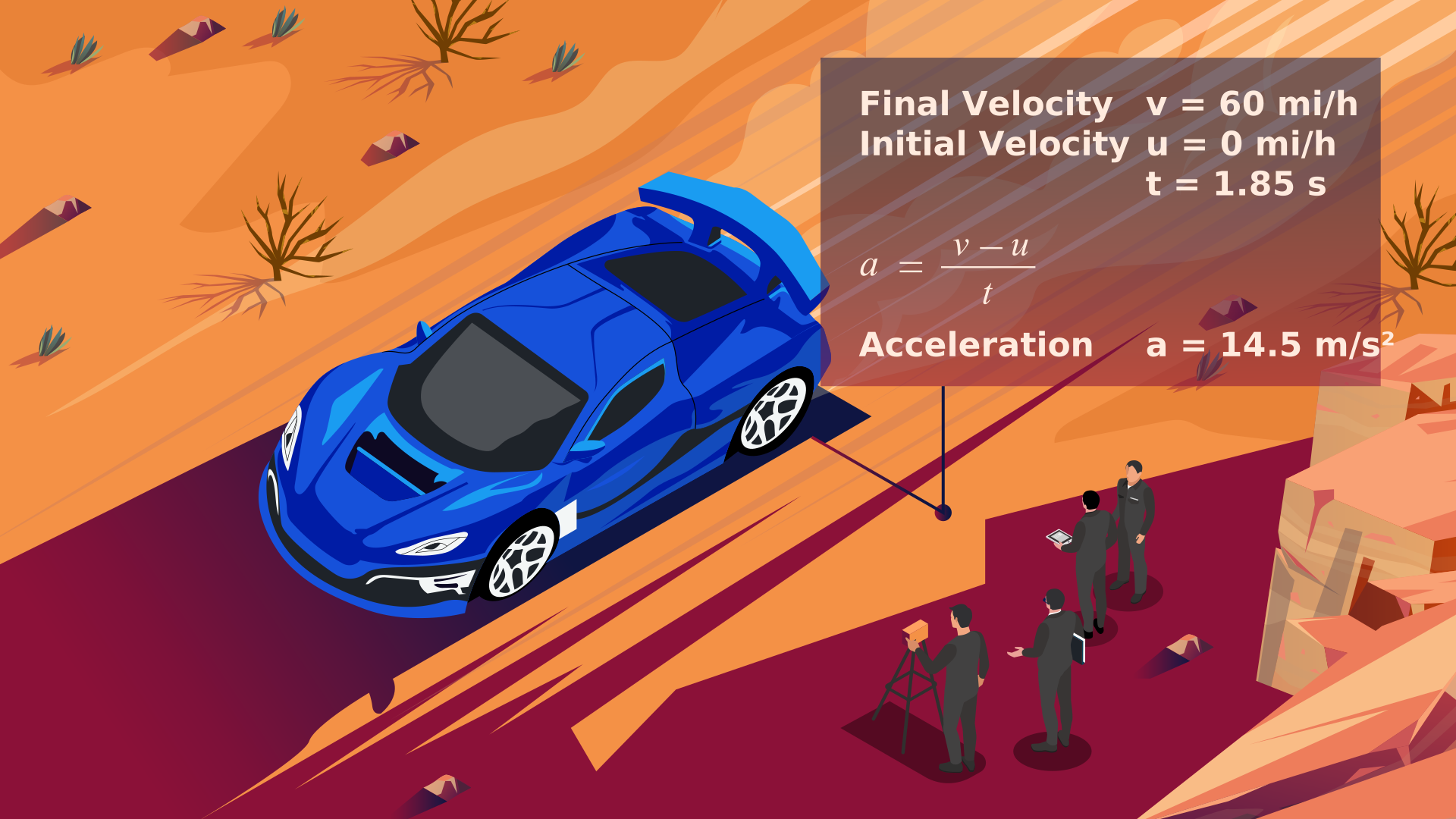
Imagine being able to calculate the precise speed of a moving object or determine exactly when it will reach its final destination. While these kinematic calculations might seem daunting, a powerful velocity calculator makes them incredibly simple.
This speed and acceleration calculator uses the fundamental kinematic formula v = u + at, where v is final velocity, u is initial velocity, a is acceleration, and t is travel time. By simply inputting any three known variables, the tool instantly finds the missing fourth. Keep in mind that the equation v = u + at assumes constant acceleration throughout the entire duration of motion.
Capable of calculating initial velocity as u = v - at, acceleration as a = (v - u)/t, and travel time as t = (v - u)/a, this versatile velocity calculator is the ultimate tool for physics students, engineers, and anyone analyzing object motion. The user-friendly interface of our velocity solver requires only your known values and seamlessly supports a wide variety of both metric and imperial units.
Whether you are a physics student analyzing projectile motion, an engineer designing advanced machinery, or a fluid dynamics enthusiast, this online velocity calculator is designed for you.
The Equations of Motion
Kinematic equations that describe the nature and behavior of a physical system are known as the equations of motion. There are three primary equations of motion used to calculate core parameters such as distance, initial and final velocity, time (t), and acceleration (a).
Below are the three standard equations of motion:
- The first equation of motion: v = u + at
- The second equation of motion: s = ut + ½ at²
- The third equation of motion: v² = u² + 2as
Where v is final velocity, u is initial velocity, t is time, a is acceleration, and s is the distance traveled.
The First Equation of Motion
In physics, the velocity equation, v = u + at, defines the relationship between an object's final velocity, its initial velocity, its acceleration, and the time required to reach that final velocity. This formula is a foundational pillar in physics and engineering for calculating linear motion.
The equation consists of four core variables:
- The initial velocity is the object's velocity at the beginning of its motion.
- The final velocity is the object's velocity at the end of its motion.
- Acceleration is the rate at which an object's velocity changes over time.
- Time is the total duration of the motion.
In simpler terms, the first equation of motion states that an object's final velocity (v) equals its starting velocity (u) plus the product of its acceleration (a) and the elapsed time (t). It perfectly illustrates how an object's speed changes over time under constant acceleration.
The First Equation Applications
The equation v = u + at is vital for comprehending and predicting the movement of physical bodies, including projectiles, waves, and mechanical systems.
Scientists frequently rely on this equation to study the behavior of projectiles. Broadly speaking, a projectile is any object thrown, shot, or projected into the air, and its motion is strictly governed by the laws of physics.
By applying the first equation of motion, we can accurately compute a projectile's trajectory. This requires accounting for variables such as initial velocity, launch angle, and air resistance. For example, by knowing the initial velocity and angle, physicists can predict the exact landing spot of anything from a baseball to a rocket.
The first equation of motion also plays a critical role in mechanical engineering. Engineers apply this formula to design and analyze the motion of machines, such as automobiles, airplanes, and robotics. They use it to calculate the precise velocity and acceleration of moving parts—like engine pistons—allowing them to build more efficient and powerful engines.
Furthermore, this kinematic equation extends to the study of waves. In general terms, waves are disturbances that propagate through space, and their physical movement can be modeled mathematically using this exact formula.
By understanding the speed and acceleration of waves, researchers and engineers can forecast wave behavior under various conditions and design systems to capture their energy. For example, engineers can optimize wave energy converters by tracking the velocity and acceleration of ocean swells. Similarly, acoustical scientists use the first equation of motion to predict how sound waves travel through different environments.
In aerospace engineering, the formula is used to compute the velocity and acceleration of aircraft, ensuring optimal flight performance.
Beyond mechanics, fields like materials science utilize this equation to observe how materials behave under dynamic loading conditions, leading to stronger, better-designed structures. In biomechanics, it is applied to study human movement, directly aiding in the development of advanced prosthetics and physical rehabilitation programs. Ultimately, the first equation of motion is a highly versatile tool applied across countless scientific disciplines.
Final Velocity Calculation
Let's explore how to use our multifunctional tool as a final velocity calculator. In this section, we will determine the final velocity of a moving object using the first equation of motion: v = u + at.
Consider a cyclist riding a bicycle with an initial velocity of 6 meters per second. Suppose the cyclist accelerates uniformly at a rate of 0.6 meters per second squared. What will be the cyclist's velocity after 20 seconds? In other words, what is the final velocity in this scenario?
By substituting the given values of initial velocity (u = 6 m/s), acceleration (a = 0.6 m/s²), and time (t = 20 s) into the velocity formula, we get:
v = u + at = 6 + (0.6 × 20) = 6 + 12 = 18 m/s
Therefore, the cyclist's final velocity after 20 seconds is 18 meters per second.
Initial Velocity Calculation
Let's examine a practical example of using the first equation of motion to find an object's starting speed. For this, we use the rearranged variation of the equation: u = v - at.
Imagine a car traveling at a final velocity of 25 meters per second, with an acceleration of 2 meters per second squared. If the car has been accelerating for 10 seconds, we can easily determine its initial velocity.
You can input these values into our initial velocity calculator to solve it instantly, or substitute the known variables—final velocity (v), acceleration (a), and time (t)—into the formula manually:
u = v - at = 25 - (2 × 10) = 25 - 20 = 5 m/s
Therefore, the initial velocity of the car in this scenario was exactly 5 meters per second.
Acceleration Calculation
To calculate acceleration, we rearrange the first equation of motion into the following format:
a = (v - u) / t
Let's find the acceleration of a vehicle by considering an example where its speed increases from 0 km/h to 100 km/h in 2.5 seconds.
It is essential to ensure that all units are consistent before performing the calculation. In this case, we must first convert the velocity from km/h to m/s.
0 km/h equals 0 m/s, and 100 km/h is equivalent to 27.78 m/s.
Given the initial velocity (u) of 0 m/s, the final velocity (v) of 27.78 m/s, and the time (t) of 2.5 seconds, we can calculate the acceleration as follows:
a = (v - u) / t = (27.78 - 0) / 2.5 = 27.78 / 2.5 = 11.11 m/s²
Thus, the acceleration of the car is 11.11 meters per second squared (often rounded to 11 m/s²).
Time Calculation
Using the formula t = (v - u) / a, you can calculate the precise time it takes for an object to reach a specific velocity or, conversely, how long it takes to decelerate.
Imagine a car traveling at an initial velocity of 60 miles per hour that begins braking to a final velocity of 20 miles per hour, experiencing a constant deceleration (negative acceleration) of -2 meters per second squared. Let’s calculate the time required for this vehicle to slow down.
First, we need to convert the car's speed from miles per hour to meters per second. 60 mph is equal to 26.82 m/s, and 20 mph is equal to 8.94 m/s.
By entering the initial velocity (26.82 m/s), final velocity (8.94 m/s), and acceleration (-2 m/s²) into the equation t = (v - u) / a, we can find the time:
t = (v - u) / a = (8.94 - 26.82) / -2 = -17.88 / -2 = 8.94 s
Therefore, the time the car needs to decelerate to 20 mph is 8.94 seconds (or roughly 9 seconds). Calculating deceleration time is incredibly valuable for automotive safety and determining optimal braking distances on various road stretches.
A Brief History of the First Equation of Motion
Aristotle is often credited as the originator of kinematics—the mathematical description of the motion of idealized objects. Thus, the conceptual roots of kinematics trace back to ancient Greece.
However, the mathematical formulation of kinematics as we know it today began taking shape in the 17th century through the pioneering work of Galileo Galilei and Sir Isaac Newton. Both of these brilliant scientific minds made monumental contributions to kinematics, laying the groundwork for modern physics.
Galileo Galilei was a true pioneer in the field. He was the first to experimentally demonstrate that the acceleration of a falling object under gravitational forces remains constant. Using a simple pendulum, he also proved that an object's velocity increases uniformly with time when subjected to constant acceleration.
Sir Isaac Newton, widely regarded as the father of modern physics, expanded on Galileo's foundational work to formulate his famous laws of motion. Newton's second law of motion states that the force exerted on an object is directly proportional to the product of that object's mass and acceleration, expressed mathematically as a = F/m.
The first equation of motion, v = u + at, which elegantly links final velocity, initial velocity, acceleration, and time, is derived from Newton's second law by assuming that the net force acting on the object remains constant.
It is crucial to remember that this specific kinematic equation is only valid under conditions of constant acceleration. In situations involving variable acceleration, calculating motion becomes more complex and requires advanced calculus to solve.
Conclusion
The fundamental velocity formula v = u + at significantly enhances our understanding of how physical bodies move and interact. It allows us to seamlessly calculate essential metrics like final velocity, initial velocity, acceleration, and travel time.
Using an online speed calculator is an excellent way to learn more about the physical world, from understanding automotive braking times and projectile trajectories to analyzing complex wave dynamics. Whether you are an experienced scientist, an engineering professional, or a curious student, this speed and acceleration calculator serves as a practical, intuitive, and highly accurate tool for all your physics calculations.