

Concrete Slab, Bag, Yard Calculator
Planning a project? Use our Concrete Slab, Bag & Yard Calculator to accurately estimate concrete volume, bags needed, and material costs for your next job.
Input Data
| Concrete Slabs, Bags and Yards | |
|---|---|
| Cubic Yards | 3.7 yd³ |
| Cubic Feet | 100 ft³ |
| Bags (60 lb) | 223 |
| Bags (80 lb) | 167 |
| Cost | $ 444.00 |
There was an error with your calculation.
How to Calculate Concrete Volume, Bags, and Cost for Any Shape
Last updated: July 21, 2026
Table of Contents
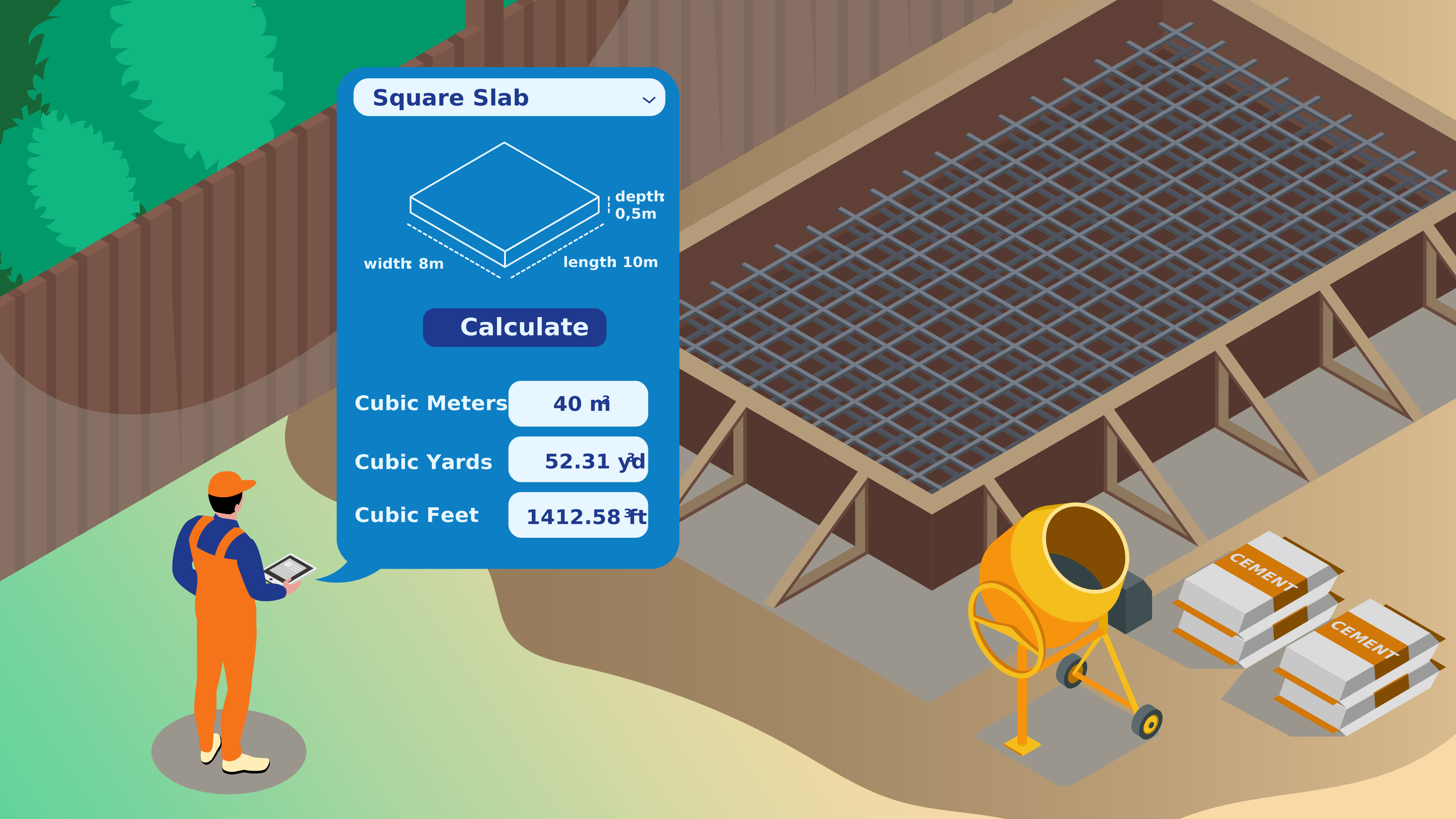
This concrete calculator quickly estimates the exact amount of concrete required for your next construction project. Whether you are using US customary units (inches and feet) or metric measurements (centimeters and meters), this versatile concrete volume calculator ensures precision for both local and international jobs.
Designed to handle a wide variety of shapes, our tool accurately calculates concrete for square slabs, round slabs, walls, foundations, square columns, round columns, steps, curbs, and gutters. There is no need to switch between a specialized concrete slab calculator, concrete column calculator, concrete steps calculator, or concrete curb calculator—this all-in-one cement calculator seamlessly handles them all.
In addition to providing clear visual guides and straightforward formulas for each shape, this tool acts as a comprehensive concrete cost estimator.
Simply enter the price of concrete per cubic foot, cubic yard, or cubic meter to instantly calculate your total material costs. This built-in pricing feature is an absolute lifesaver for builders, contractors, and DIY enthusiasts who need to budget and plan their projects with pinpoint accuracy.
Concrete Volume Calculation Formulas
Square Slab, Wall, Footer or Square Column
The formula for determining the volume of a square slab is straightforward. You can calculate the required volume by multiplying the slab's width, length, and depth (or height).
Volume = Width × Length × Depth
You can apply this same fundamental principle to find the volume of a wall, foundation, or square column.
Round slab or Round Column
The concrete calculator formula for a round slab is slightly different. First, determine the area of the circle by multiplying π (3.14) by the square of half the slab's diameter (the radius).
Area of the Circle = π × (Diameter/2)²
Next, calculate the total volume by multiplying this circular area by the slab's depth or height.
Volume = Depth × Area
You can calculate the volume of a circular column using this exact same method.
Steps or Curbs & Gutters
Calculating the volume for concrete steps is significantly more complex, making a dedicated concrete steps calculator highly recommended. For stairs, this cement calculator factors in the platform's depth, rise, run, width, and the total number of steps, delivering precise volume estimates in a fraction of a second.
By entering your specific measurements and leveraging these built-in formulas, you can instantly determine exactly how much concrete your project requires.
Using the Concrete Calculator
To use the tool, select the specific concrete form you plan to build. Next, enter the dimensions in your preferred imperial units (inches or feet) or metric units (centimeters or meters). The calculator will instantly output the required concrete volume in cubic yards (or your chosen metric equivalent).
Example 1
Suppose you are building a concrete wall that is 10 feet long, 4 feet high, and 6 inches thick.
Manual Calculation
Let's compare a manual calculation to the calculator's output. First, convert the wall thickness from inches to feet to ensure all units are consistent.
6 inches = 0.5 ft.
Now, substitute these dimensions into the volume formula:
Volume = Width × Length × Depth = 0.5 × 10 × 4 = 20 ft³
Calculations with a Concrete Calculator
To find the required concrete volume using our tool, select "wall" from the menu and enter your dimensions: 10 feet, 4 feet, and 6 inches.
The calculator will instantly display the concrete volume needed: 20 ft³ or 0.74 yd³.
You can also determine your total material costs by entering the local price per cubic foot, cubic yard, or cubic meter.
For instance, if the current price for one cubic yard of concrete is $120, the concrete cost calculator will quickly compute the final material cost:
Cost = $ 88.80 at $ 120.00 per cubic yard
Example 2
Another common scenario is filling cylindrical concrete forms. Let's say you need to fill 50 pipe forms that are each 4 feet high and 10 inches in diameter.
Manual calculations
First, let's determine the volume manually using the formula. Just like in the previous example, start by converting inches to feet.
10 inches = 0.8334 feet.
Next, calculate the area of the concrete base.
Circle area = π × (Diameter/2)² = 3.1416 × (0.8334/2)² = 3.1416 × 0.4167² = 3.1416 × 0.1736 = 0.5454 ft²
Now, multiply this base area by the height of the pipe to find the volume of a single form.
Volume = Height × Area = 0.5454 × 4 = 2.1816 ft³
Since you are filling 50 forms, multiply this single-pipe volume by 50 to get your total requirement.
2.1816 × 50 = 109.08 feet³
Calculations with a Concrete Calculator
To calculate this project's volume digitally, select "round columns" on the calculator, then input a height of 4 feet and a diameter of 10 inches.
The tool will instantly output the volume for a single pipe: 2.18 ft³ or 0.08 yd³.
To find the total volume for all 50 pipes, it multiplies the precise single-pipe volume by 50, yielding 109.08 ft³ — which converts to 4.04 yd³.
Assuming the same concrete pricing of $120 per cubic yard, the tool multiplies your total yardage by the unit price.
Cost = $ 484.80 at $ 120.00 per cubic yard
Our concrete estimator delivers these precise calculations seamlessly, saving you time and effort.
How Many Bags of Concrete Do You Need?
For smaller projects, buying bagged concrete mix is often more practical than ordering ready-mix by the yard. To convert your calculated volume into a bag count, divide it by the yield of a single bag: a standard 60 lb bag yields approximately 0.45 ft³ of mixed concrete, while an 80 lb bag yields approximately 0.60 ft³. Always round the result up to the next whole bag.
Take the slab from our first example, which required 20 ft³ of concrete. With 80 lb bags, you would need 20 ÷ 0.60 = 33.4, or 34 bags once rounded up. Using 60 lb bags instead, the same pour would take 20 ÷ 0.45 = 44.5, or 45 bags.
Our calculator performs this conversion automatically, showing the bag counts for both common sizes alongside the volume in cubic feet and cubic yards. As with ready-mix orders, it is wise to purchase 5–10% more bags than the raw calculation suggests to cover spillage, uneven subgrade, and mixing losses — unopened bags can usually be returned.
Factors to Consider
When determining the total amount of concrete required for a project, calculating the raw volume is only the first step. You must also account for several critical project variables.
Concrete thickness
The thickness of your pour is foundational to calculating total volume. Naturally, thicker slabs and walls require significantly more concrete. Structural engineers determine the optimal concrete thickness based on the structure's load-bearing capacity, anticipated weight loads, and underlying soil conditions.
For instance, a concrete driveway subjected to heavy vehicle traffic requires a much thicker slab than a pedestrian walkway. Concrete thickness directly dictates structural durability and strength. Miscalculating this specification can lead to catastrophic structural failures or highly expensive future repairs.
Compressive strength
Compressive strength measures the concrete's ability to withstand heavy compression loads. Engineers specify a required compressive strength based on the building type, expected daily loads, and environmental factors. Achieving a higher compressive strength typically requires a mix with more cement and less water, producing a higher-density end product.
A highway bridge, for example, demands a vastly higher compressive strength than a residential patio. Factoring in compressive strength is vital, as it ensures long-term structural integrity and guarantees the safety of the building's occupants.
Density
Density refers to the weight of the concrete per unit of volume. A high-density concrete mix requires more raw materials than a lower-density alternative. The density is primarily influenced by the type and proportion of aggregate used in the mix. Engineers select a specific concrete density to meet the strict structural strength requirements of a project. Ultimately, the density impacts the total structural weight, which in turn affects material quantities, labor requirements, and overall project costs.
Waste factor
The waste factor provides a safety net for spillage, over-excavation, settling, or other minor losses that inevitably occur during the mixing, pouring, and finishing processes. Factoring in waste is critical to ensure you don't run short on concrete mid-pour, helping you avoid costly project delays or emergency delivery fees. Industry professionals typically add a 5–10% waste factor margin to their initial volume estimates.
Weather conditions
Environmental conditions on the day of the pour—such as temperature, humidity, and wind—directly affect the water-to-cement ratio and the workability of the concrete. For example, pouring concrete on a hot, arid day causes faster evaporation, often requiring additional water or specialized admixtures to keep the concrete workable.
Engineers carefully weigh local weather conditions when finalizing concrete volume and mix design. Monitoring the weather is essential because temperature variations significantly influence the concrete's setting time, curing process, final strength, and overall durability.
Cement type
Different types of cement have varying requirements for water content and aggregate mixtures. Engineers select a specific cement type based on structural strength targets and anticipated environmental conditions during the pour. The chosen cement type will influence the setting time, durability, necessary material quantities, labor demands, and bottom-line costs.
Specialized cement blends—such as sulfate-resistant, high-alumina, low-heat, rapid-hardening, hydraulic, expansive, or air-entraining cements—are formulated for highly specific applications. Consequently, selecting the most appropriate cement mix is fundamental to achieving a project's distinct structural goals.
When estimating concrete yardage for any construction job, comprehensively evaluating all these variables is crucial. Doing so ensures your project stays on schedule, remains within budget, and meets all rigorous standards for structural strength and longevity.
Conclusion
A reliable concrete calculator is an indispensable tool for anyone working with cement, from large-scale commercial construction crews to weekend DIYers. By quickly and accurately calculating the required yardage for diverse geometric forms, this tool takes the guesswork out of material planning. Understanding how the calculator processes your inputs and unit measurements guarantees flawless project estimates.
Leveraging a dedicated concrete volume calculator saves you valuable time and money by eliminating the risk of human error associated with manual math. A specialized concrete cost estimator streamlines your planning phase, making it easier and far more cost-effective to execute a successful, professional-grade construction project.