
Cubic Yards Calculator
Easily calculate cubic yards for concrete, soil, mulch, and landscaping projects. Enter your measurements for instant and accurate volume conversions.


| Result | |
|---|---|
| Cubic Yards | 0.29834 yd³ |
| Cubic Feet | 8.05511 ft³ |
| Cubic Meters | 0.2281 m³ |
| Price | 2.98337 $ |
There was an error with your calculation.
Last updated: June 3, 2026
Table of Contents
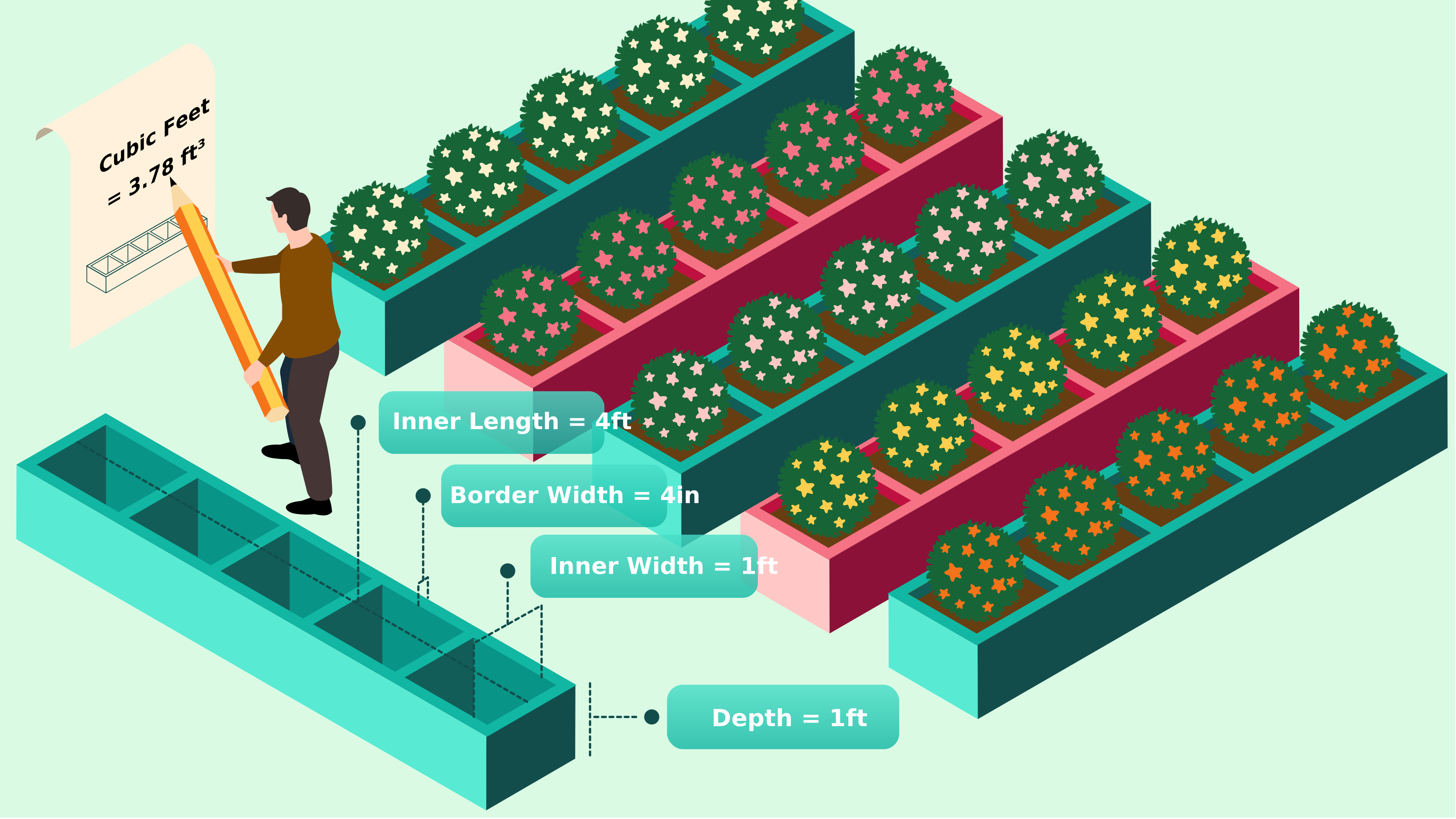
Whether you are planning a major construction job or a weekend landscaping project, a reliable cubic yard calculator is an essential tool. It helps you quickly calculate cubic yards to determine exactly how much gravel, crushed stone, pebbles, cement, sand, or mulch you need to fill a specific volume.
Our cubic yardage calculator computes the volume of spaces with various base shapes, including squares, rectangles, rectangular frames, circles, circular frames, triangles, and trapezoids. By multiplying the area of these geometric shapes by their depth or height, the yard calculator instantly delivers highly accurate volume measurements in cubic yards, cubic feet, and cubic meters.
This versatile yardage calculator accepts inches, feet, centimeters, and meters as input units. You can even mix and match different units for a single object—the calculator handles all the complex conversions automatically. Additionally, this online cubic yard calculator can seamlessly estimate the total cost of materials based on your aggregate's price per cubic foot, cubic yard, or cubic meter.
Applications
The value of a precise cubic yard calculator in construction and landscaping cannot be overstated. By accurately determining exact material quantities, it saves builders, contractors, and DIY enthusiasts both time and money. This tool allows you to budget with confidence and perfectly plan your next design or construction phase.
A cubic yard calculator is incredibly handy for calculating the exact amount of concrete needed for slabs, walls, foundations, or columns. It is also the perfect tool for calculating the volume of any landscape filler. As a result, professionals use precise material volumes when executing their plans, drastically reducing waste and keeping projects strictly within budget.
Practical Examples
Let's break down the formulas and area calculations powering this tool, so you can fully understand how to calculate cubic yards.
Square Area and Rectangle Area
First, let's look at the differences between square and rectangular bases. You can calculate the base area of a square by simply squaring the side length, since all sides are equal. To find the area of a rectangle, you multiply the length by the width. The formulas are as follows:
Square Area (yd²) = Length²
Rectangle Area (yd²) = Length × Width
To measure the total volume, we multiply this base area by the height or depth of the object. To calculate cubic yards, we use this general formula:
Volume (yd³) = Area × Depth
For more specific shapes, you can use this formula for a square volume:
Volume (yd³) = (Side Length²) × Depth
And for a rectangular volume:
Volume (yd³) = (Length × Width) × Depth
Consider this practical scenario: We have a patch of soil that we want to cover with mulch to retain moisture, improve air exchange at the roots, and enhance the soil structure. The area is rectangular, measuring 3 feet wide by 10 feet long. We want to fill it with a 2-inch layer of mulch.
Let's start by determining the base area by multiplying the length by the width.
Rectangle Area (ft²) = Length × Width = 10 × 3 = 30 (ft²)
Next, we multiply that area by the depth to get the volume. It is crucial to remember to convert inches to feet to keep all units uniform. In this case, 2 inches equals 0.166667 feet.
Volume (ft³) = Area × Depth = 30 × 0.166667 = 5.00001 (ft³)
Our cubic yard calculator instantly processes this information and displays the results in three different units.
Answer
- Cubic Yards = 0.19 yd³
- Cubic Feet = 5 ft³
- Cubic Meters = 0.14 m³
The best part? You don't have to worry about manually converting inches to feet. The cubic yard calculator automatically handles all unit conversions for you.
Rectangle Border Area
When calculating the volume for a rectangular border or curb, the math requires a few more steps. Let's explore the algorithm this calculator uses.
It first calculates the interior area based on the inside length and width. Next, it calculates the exterior area by adding the border's width to the inside dimensions. By subtracting the interior area from the exterior area, it finds the exact area of the border. Finally, multiplying this border area by the depth or height gives us the total volume.
Here are the formulas used in this process.
Calculating the area of the outer and inner areas:
Inner Area (ft²) = Inner Length × Inner Width
Outer Area (ft²) = (Inner Length + border × 2) × (Inner Width + border × 2)
Calculating the difference between them:
Border Area (ft²) = Outer Area (ft²) - Inner Area (ft²)
And finally, calculating the volume:
Volume (ft³) = Depth (ft) × Border Area (ft²)
Let's calculate the volume of concrete required to fill decorative garden border forms. For this project, let's say the designer provided measurements in meters and centimeters to demonstrate how the calculator's built-in conversions are highly advantageous.
The interior dimensions are 1 (m) × 0.3 (m). The border width is 0.05 (m), and the form's total height (depth) is 0.3 (m).
Inner Area (m²) = Inner Length × Inner Width = 1 × 0.3 = 0.3 (m²)
Outer Area (m²) = (Inner Length + border × 2) × (Inner Width + border × 2) = (1 + 0.05 × 2) × (0.3 + 0.05 × 2) = 1.1 × 0.4 = 0.44 (m²)
Border Area (m²) = Outer Area (m²) - Inner Area (m²) = 0.44 - 0.3 = 0.14 (m²)
Volume (m³) = Depth (m) × Border Area (m²) = 0.3 × 0.14 = 0.042 (m³)
To convert cubic meters to cubic feet, we multiply the result by 35.3147.
Volume (ft³) = Volume (m³) × 35.3147 = 0.042 × 35.3147 = 1.4832174 (ft³)
To convert cubic meters to cubic yards, we multiply the result by 1.30795.
Volume (yd³) = Volume (m³) × 1.30795 = 0.042 × 1.30795 = 0.0549339 (yd³)
Rather than doing this manually, our yard calculator delivers this exact data in multiple units in a fraction of a second:
Answer
- Cubic Yards = 0.05 yd³
- Cubic Feet = 1.48 ft³
- Cubic Meters = 0.04 m³
Circle Area
Next, let's look at circular areas. To calculate the volume of a space with a circular base, we use the standard formula for the area of a circle:
Area (ft²) = π × (Diameter / 2)²
If you already know the radius of the circle, you can apply this alternative formula:
Area (ft²) = π × r²
We then multiply this base area by the object's depth or height to find the total volume.
Volume (ft³) = Area × Depth
The result is the total volume expressed in cubic feet.
Let's look at an example from a landscape design project. We are building a circular ornamental rock garden with a diameter of 10 feet. We want to fill this area with a 2-inch layer of gravel.
First, we determine the area by multiplying π (3.14) by the squared result of the diameter divided by 2.
Area (ft²) = π × (Diameter / 2)² = 3.14 × (10 / 2)² = 3.14 × 25 = 78.5 (ft²)
This calculation gives us a base area of 78.5 square feet.
Next, we convert our depth measurement from inches to feet (2 inches equals 0.166667 feet).
Now, we multiply the area of 78.5 square feet by the depth of 0.166667 ft.
Volume (ft³) = Area × Depth = 78.5 × 0.166667 = 13.0833595 (ft³)
Our manual calculation yields 13.0833595 cubic feet—the exact volume of gravel needed.
When using the calculator, it instantly provides these rounded, accurate values:
Answer
- Cubic Yards = 0.48 yd³
- Cubic Feet = 13.09 ft³
- Cubic Meters = 0.37 m³
Circle Border Area
Now let's examine circular boundary areas, commonly known as ring areas. These ring-shaped bases feature both an outer and an inner diameter. To find the area of a circular border, our calculator first calculates the area of the inner circle.
Inner Area (ft²) = π × (Inner Diameter/2)²
Then, it determines the diameter and area of the outer circle using the border width.
Outer Diameter = Inner Diameter + (Border Width × 2)
Outer Area (ft²) = π × (Outer Diameter/2)²
By subtracting the inner area from the outer area, you get the true area of the circular border base.
Area (ft²) = Outer Area - Inner Area
Finally, multiplying this base area by the depth yields the total volume.
Volume (ft³) = Area × Depth
Let's look at an example for clarity.
Imagine a park installing a circular flowerbed enclosed by a poured concrete border. The inside diameter of the concrete mold is 6 feet, the border is 6 inches wide, and the height is 10 inches. We need to calculate the mold's volume to determine how much concrete is required.
First, let's calculate the area of the inner circle.
Inner Area (ft²) = π × (Inner Diameter/2)² = 3.14 × (6 / 2)² = 28.26 (ft²)
Next, we calculate the diameter and area of the outer circle. Remember to convert the 6-inch border width into feet (0.5 ft).
Outer Diameter = Inner Diameter + (Border Width × 2) = 6 + (0.5 × 2) = 6 + 1 = 7 ft
Outer Area (ft²) = π × (Outer Diameter / 2)² = 3.14 × (7 / 2)² = 38.465 (ft²)
Now we find the area of the circular base by subtracting the inner area from the outer area.
Area (ft²) = Outer Area - Inner Area = 38.465 - 28.26 = 10.205 (ft²)
Finally, we calculate the total volume by multiplying the border area by the mold's height (depth). Again, we must convert the 10-inch height into feet (0.833333 ft).
Volume (ft³) = Area × Depth = 10.205 × 0.833333 = 8.504163265 (ft³)
This tool instantly provides the answer, saving you from cumbersome calculations and manual unit conversions:
Answer
- Cubic Yards = 0.32 yd³
- Cubic Feet = 8.51 ft³
- Cubic Meters = 0.24 m³
Triangle Area
In geometry, Heron's formula is often used to determine the area of a triangle based on its three sides:
$$Area\ (ft^{2})=\frac{1}{4}×\sqrt[2]{(a+b+c)×(b+c-a)×(c+a-b)×(a+b-c)}$$
By multiplying this base area by the height or depth of the object, we determine its volume.
Volume (ft³) = Area × Depth
Let's study a practical design example. Suppose a designer creates a blueprint for a concrete bollard with a triangular base, intended to support a custom bench. The base is an equilateral triangle with a side length of 3 feet, and its height will be 1.5 feet. Let's calculate the volume of concrete needed to cast this bollard.
$$Area\ (ft^{2})=\frac{1}{4}×\sqrt[2]{(a+b+c)×(b+c-a)×(c+a-b)×(a+b-c)}=\frac{1}{4}×\sqrt[2]{9 × 3 × 3 × 3}=\frac{1}{4}×\sqrt[2]{243}=\frac{1}{4}×15.5884572681199=3.897114317029974$$
Volume (ft³) = Area × Depth = 3.897114317029974 × 1.5 = 5.845671475544961 (ft³)
By entering these dimensions, the calculator instantly delivers the following precise results:
- Cubic Yards = 0.22 yd³
- Cubic Feet = 5.85 ft³
- Cubic Meters = 0.17 m³
Trapezoid Area
To determine the area of a trapezoid, we apply the following formula:
Area (ft²) = ((a + b) / 2) h
In this equation, a represents the length of the smaller base, b is the length of the larger base, and h is the height (or distance between the parallel bases).
Once we know the area of the trapezoid, calculating the total volume of the object is quick and easy. We simply apply our standard volume formula:
Volume (ft³) = Area × Depth
Let's examine one final example. A client has a small trapezoidal area in their garden that needs to be filled with gravel to a depth of 2 inches. The shorter side of the area measures 5 feet, the longer side is 7 feet, and the distance between these two parallel sides is 8 feet. Let's calculate the amount of gravel required.
First, we calculate the area of the trapezoidal base:
Area (ft²) = ((a + b) / 2) h = ((5 + 7) / 2) 8 = 48 (ft²)
Now, we multiply the base area by the depth to find the volume. Before doing so, we convert the 2-inch depth into feet (since 1 inch equals 0.0833333 feet, 2 inches becomes 0.166667 ft).
Volume (ft³) = Area × Depth = 0.166667 × 48 = 8.000016 (ft³)
Our yardage calculator instantly processes this data to give us:
- Cubic Yards = 0.30 yd³
- Cubic Feet = 8 ft³
- Cubic Meters = 0.23 m³
Conclusion
Calculating cubic yards manually isn't overly complicated if you know the correct formulas and apply precise measurements. However, manual calculation takes time and leaves room for mathematical errors.
The true convenience of a dedicated cubic yard calculator lies in its automation. You don't need to memorize complex geometric formulas or constantly convert measurement units to match. Furthermore, the tool instantly generates highly accurate results in both imperial and metric units.
Whether you are managing a large-scale construction site or planning a backyard landscape design, using a cubic yard calculator ensures you always know the exact volume of materials required for any shape, area, and depth. Save time, reduce material waste, and keep your next project perfectly on budget!