Home Loan Calculator
Easily estimate your monthly mortgage payments with our free Home Loan Calculator. View amortization schedules for fixed and adjustable-rate loans instantly.
Input Data
Home Loan
| Monthly Payment | $1,816.92 |
|---|---|
| Property Tax | $144,000.00 |
| Home Insurance | $36,000.00 |
| Total Out-of-Pocket | $834,091.20 |
| House Price | $400,000.00 |
Interest
Principal
There was an error with your calculation.
How Mortgages Work: Rates, Payments, and the Home-Buying Process
Last updated: July 21, 2026
Table of Contents
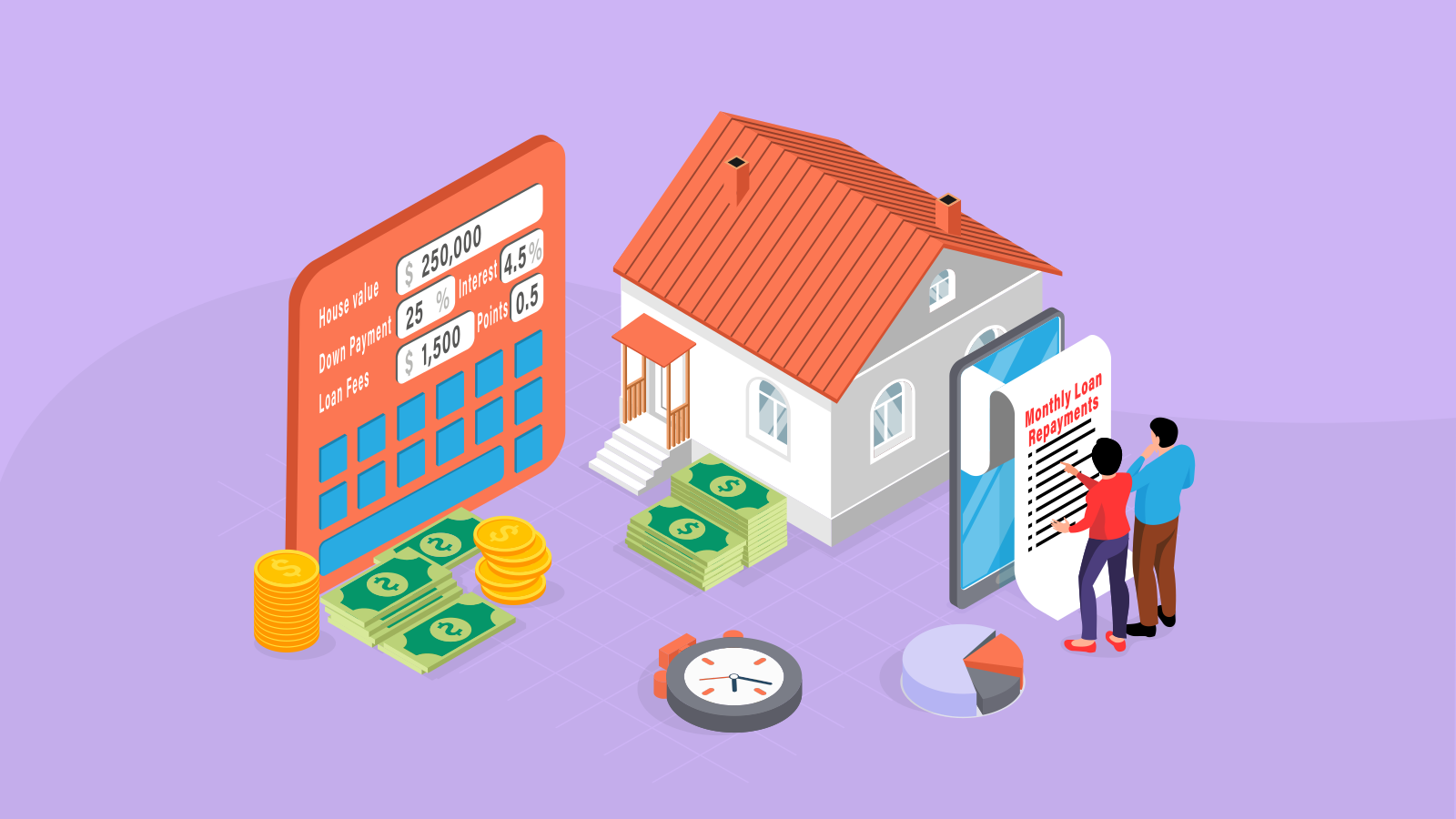
Whether you’re a first-time homebuyer or looking to refinance an existing property, our mortgage calculator can help you accurately estimate your monthly payments. Understanding how your down payment, interest rate, loan term, property taxes, and location impact your true monthly cost is essential for smart financial planning. Keep reading to explore how a mortgage payment calculator works, dive into the home-buying process, and discover how to secure the best mortgage rates.
Mortgage Definition
A mortgage is a specific type of loan used to purchase, maintain, or develop real estate. Functioning as a secured loan, the property itself serves as collateral. When you take out a mortgage, you enter into a binding legal agreement with a lender, committing to repay the loan principal plus interest through regular, structured payments over a predetermined timeframe.
Applying for a mortgage typically involves working with a bank, credit union, or private lender. The lender assesses your financial profile—including your credit score, income, and down payment—to determine your eligibility. Before reaching the closing phase, every mortgage application undergoes a rigorous underwriting process. Once approved, borrowers can choose from several types of home loans, such as conventional loans or fixed-rate mortgages.
How Mortgages Work
Mortgages empower individuals and businesses to purchase real estate without needing to pay the entire purchase price upfront. Once a home loan is approved, the borrower commits to repaying the principal amount along with interest over a set number of years. When the debt is fully repaid, the borrower owns the property free and clear.
Most traditional home loans follow a standardized mortgage amortization schedule, ensuring your base monthly payment remains relatively consistent. However, the exact proportion of your payment applied to the principal versus the interest will shift over the life of the loan. In the United States, the most common mortgage terms are 15 and 30 years.
Legally, a mortgage acts as a lien or claim against your property. This means that if a borrower fails to adhere to the agreed-upon mortgage amortization schedule, the lender retains the right to foreclose on the real estate. During a foreclosure proceeding, the lender can legally evict the occupants, sell the property, and use the proceeds to recover the outstanding mortgage debt.
The Mortgage Process
The mortgage process begins when a prospective homebuyer submits a loan application to one or multiple lenders. To verify that you can comfortably repay the loan, lenders require comprehensive financial documentation. This typically includes bank and investment statements, proof of income, employment verification, and recent tax returns. Additionally, the lender will pull your credit report to review your payment history and current debt levels.
To gain a competitive edge in the housing market, it is highly recommended to secure a mortgage pre-approval before shopping for a home. A pre-approval letter signals to sellers that you are a serious buyer with the financial backing to support your offer.
Once a buyer and seller agree on the purchase terms, the transaction moves toward the closing phase. At closing, the buyer (or their representative) finalizes the paperwork, provides the down payment, and pays any closing costs or origination fees—which may sometimes include mortgage points paid to lower the interest rate. Finally, the seller transfers the property ownership, and the buyer officially receives the keys to their new home.
Types of Mortgages
There are many types of mortgage loans designed to fit different financial situations. While 15-year and 30-year fixed-rate mortgages are the most common, terms can range from as short as five years to as long as 40 years. By utilizing an amortization calculator, you’ll discover that stretching your loan over a longer term lowers your monthly mortgage payment, but ultimately increases the total interest paid over the life of the loan.
Beyond the loan term, mortgages also vary by program type. Government-backed mortgages—such as VA (Department of Veterans Affairs) loans, FHA (Federal Housing Administration) loans, and USDA (Department of Agriculture) loans—are specifically designed to help buyers who may lack the high credit scores, large down payments, or income history required for conventional home loans.
Here’s a closer look at the primary mortgage structures:
Adjustable-Rate
Adjustable-rate mortgages (ARMs) feature a fixed interest rate for an initial introductory period, after which the rate fluctuates based on broader market conditions. Because the starting rate is typically lower than the current market average, ARMs offer highly affordable initial payments. However, they carry the risk of becoming substantially more expensive if interest rates rise sharply in the future. To protect borrowers, these loans usually include rate caps that limit how much the interest can increase per adjustment period and over the entire loan term.
Interest-Only
Interest-only mortgages are highly specialized and typically involve complex amortization schedules best suited for sophisticated investors or high-net-worth borrowers. During the introductory phase, your monthly payment covers only the interest, keeping initial costs extremely low. However, buyers must be cautious: these loans often require a massive balloon payment to cover the principal at the end of the term. Historically, this mortgage structure contributed heavily to the financial distress many homeowners faced during the early 2000s housing crisis.
Fixed-Rate
Fixed-rate mortgages are the most popular home loans on the market because they provide predictable, stable budgeting. Once your loan is originated and the interest rate is locked in, your principal and interest payment will never change unless you choose to refinance. While fixed rates shield you from rising inflation, you also won't automatically benefit if market interest rates drop over time, as you would with an adjustable-rate mortgage.
Reverse Mortgages
Reverse mortgages are unique financial instruments designed specifically for homeowners aged 62 and older who want to convert a portion of their home equity into liquid cash. Instead of making monthly payments to a lender, the homeowner borrows against the home's value and receives funds as a lump sum, a fixed monthly payout, or a line of credit. The accumulated loan balance only becomes due when the borrower passes away, permanently moves out, or sells the property.
Understanding Average Mortgage Rates
The total cost of your mortgage is heavily dictated by the loan type, loan term, current market interest rates, and whether you purchase discount points. Because interest rates fluctuate daily and vary significantly between lenders, it is crucial to shop around and compare multiple rate quotes.
Historically, mortgage rates experience natural cycles of volatility. For context, in 2020, U.S. mortgage rates hit near-record lows, with the average 30-year fixed rate dropping to around 2.66%. While rates remained highly favorable through most of 2021, they began trending upward toward the end of that year. To illustrate market shifts, here is a historical snapshot of average home loan interest rates as recorded in September 2022 (these figures are historical, not current):
- Fixed-rate 30-year mortgage: 6.89%
- Fixed-rate 15-year mortgage: 5.528%
- 10/6 Adjustable-rate mortgage: 6.435%
Payments Included in a Mortgage
Your monthly mortgage payment is generally comprised of four main components, often referred to as PITI: Principal, Interest, Taxes, and Insurance. To illustrate how a mortgage payment calculation breaks this down, we will use a $100,000 home loan as our baseline example.
Principal
A portion of every standard monthly mortgage payment goes directly toward reducing your loan’s principal balance—the actual amount you borrowed. Thanks to how mortgages are amortized, early payments are heavily weighted toward interest, with very little going toward the principal. Over time, this ratio flips, and payments made near the end of your loan term apply mostly to the principal. In our example, the starting principal balance is $100,000.
Interest
Interest is the fee your lender charges in exchange for taking on the risk of loaning you the money. This rate directly determines the size of your monthly payment; a higher interest rate equals a higher monthly mortgage payment.
It is vital to mention that higher interest rates reduce your overall borrowing power, while lower rates increase the home price you can afford. For example, if your $100,000 principal carries a 6% interest rate on a 30-year loan, your combined principal and interest payment would be roughly $600, depending on your exact location. However, if that same $100,000 loan had a 9% interest rate, your monthly obligation would surge closer to $800.
Taxes
Local governments assess property taxes (or real estate taxes) to fund essential public programs such as schools, police, and fire departments. Although property taxes are evaluated annually, most homeowners pay them in monthly installments rolled into their mortgage payment. Your lender divides your annual tax bill by 12, collects the funds monthly, and deposits them into an escrow account until the tax bill is due.
Insurance
The final factor impacting your monthly mortgage payment is insurance, which functions similarly to property taxes via an escrow account. Keep in mind that two distinct types of insurance may appear on your mortgage amortization schedule:
- Property/Homeowners Insurance: This safeguards your property and personal belongings against catastrophic events like fires, storms, or theft.
- Private Mortgage Insurance (PMI): This is typically mandatory for conventional borrowers who purchase a home with less than a 20% down payment. PMI exists strictly to protect the lender in case the borrower defaults on the loan. By mitigating the lender's risk, PMI allows everyday buyers to secure mortgages and enables lenders to sell these mortgages to investors with confidence. Once you build up a minimum of 20% equity in your home, this coverage can usually be dropped.
Note: While principal, interest, taxes, and insurance make up the bulk of most standard mortgages, you can sometimes opt for a home loan structure that does not escrow taxes and insurance. While this lowers the direct payment sent to your lender, you remain independently responsible for paying your tax and insurance premiums in full.
How to Find the Best Mortgage
In the past, traditional banks, credit unions, and savings institutions were the primary avenues for securing a home loan. Today, the real estate market is flooded with diverse options, including online non-bank lenders.
When shopping for the best rate, always use a free mortgage calculator to help compare estimated payments across different loan types, interest rates, and down payment scenarios. A mortgage calculator is also an invaluable tool for reverse-engineering your budget to determine exactly how much house you can comfortably afford.
Remember that beyond basic principal and interest, your mortgage servicer or lender will likely open an escrow account to manage property taxes, insurance, and other localized expenses. These costs are directly added to your monthly loan payments.
Ultimately, diligently shopping around is the easiest way to find the best mortgage. After using an amortization calculator to establish your budget, you must find a lender offering favorable loan terms that fit securely within those financial limits.
How to Qualify for a Mortgage
Lenders scrutinize several vital financial metrics to determine if a person qualifies for a home loan. Before submitting a mortgage application, ask yourself the following questions:
- Do you struggle with a low credit score?
- Have you recently filed for bankruptcy or experienced a foreclosure?
- Do you already carry a heavy load of existing monthly debt?
- Does your credit history reveal accounts in collections or a pattern of late payments?
- Are your credit cards currently maxed out?
Answering "yes" to just one of these questions does not automatically count you out. For instance, certain government-backed loans allow for credit scores as low as 580. However, if you answered yes to multiple questions on this list, it is highly recommended to proactively improve those financial areas, pay down debt, and boost your credit score before applying with a lender.
Important Mortgage Terminology to Know
An online mortgage loan calculator can rapidly estimate your monthly payments using just a few key data points. To use the calculator effectively, you should familiarize yourself with the following terminology:
- Home Price: The total dollar amount you agree to pay for the property.
- Down Payment: The upfront cash given to the home’s seller.
- Loan Amount: The total sum of money being financed to buy the home. You calculate this by subtracting your down payment from the final home price.
- Loan Term: The lifespan of your mortgage, or the length of time you have to repay the loan.
- Interest Rate: The percentage paid to the lender for the privilege of borrowing their capital.
Example of Calculating a Mortgage in the U.S.
Let’s suppose the home you want to buy is priced at $100,000. Your lender offers you a 30-year fixed-rate mortgage at a 6% interest rate. To accurately forecast your monthly obligation, simply use our free mortgage calculator and input this data:
- Purchase Price: $100,000
- Down Payment: We used 20% for our example
- Mortgage Term: 30-year fixed-rate
- Zip Code: We used 90005 for our example
As you’ll see, the estimated monthly payment on an $80,000 loan—factoring in principal, interest, and estimated local property costs—would be $622.90.