Right Triangle
Instantly solve any right triangle! Use our Right Triangle Calculator to find missing sides, angles, area, perimeter, altitude, and hypotenuse with ease.
Input Data
| Right Triangle | |||
|---|---|---|---|
| a | 3 | ||
| b | 4 | ||
| c | 5 | ||
| h | 2.4 | ||
| α | 36.8699° = 0.6435011 rad | ||
| β | 53.1301° = 0.9272952 rad | ||
| area | 6 | inradius | 1 |
| perimeter | 12 | circumradius | 2.5 |
There was an error with your calculation.
How to Solve a Right Triangle: Sides, Angles, Area, and More
Last updated: July 28, 2026
Table of Contents
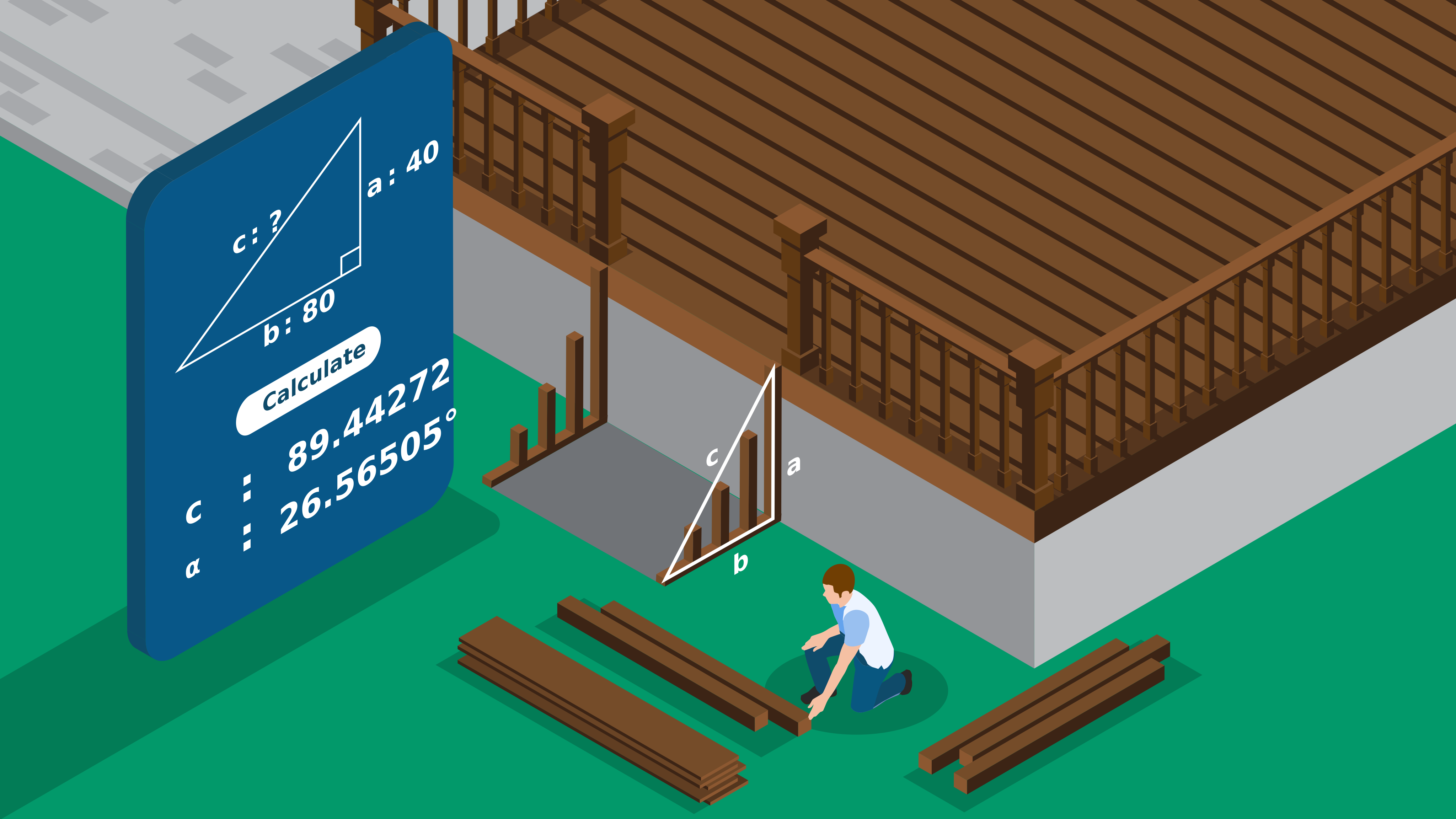
Our right triangle calculator is a versatile online triangle solver dedicated exclusively to right-angled triangles. Whether you need to find missing sides, angles, or other properties, simply input any two known values, and the calculator will instantly determine the rest. Supported inputs include the side lengths (a, b, and c), acute angles (α and β), perimeter (P), area (A), and the altitude to the hypotenuse (h).
To use the calculator, enter any two of the aforementioned values and click "Calculate."
You can input angle values in either degrees or radians. To use radians involving π, simply type "pi." For instance, if your angle is π/3, enter "pi/3."
Along with the missing values, this right triangle solver provides detailed, step-by-step calculation steps. It also generates a proportionally scaled visual representation of your triangle, along with the precise values for its inradius and circumradius.
Limitations on the input values of the triangle calculator
- You can only input exactly two values.
- The angle values of α and β must be strictly less than 90° or (π/2) rad.
- The length of the altitude to the hypotenuse (h) cannot exceed the length of either leg (a or b).
- The length of each side of the triangle (a, b, or c) must be less than the sum of the other two sides.
- For any given hypotenuse length, the triangle has a maximum possible perimeter. The calculator will not accept any perimeter exceeding this limit. The maximum perimeter of a right triangle with a given hypotenuse occurs when the triangle is isosceles (a=b). In this case, \$a=b=\frac{c}{\sqrt2}\$, and the maximum perimeter is \$P=a+b+c=c+\frac{2c}{\sqrt2}\$.
Right triangle: definition and helpful information
A right triangle (or right-angled triangle) is a polygon in which one interior angle measures exactly 90° or \$\frac{π}2\ rad\$. The side directly opposite the right angle is known as the hypotenuse. The other two sides forming the right angle are referred to as the legs, or catheti, of the triangle.
Often, leg b is considered the base of the right triangle, while leg a represents its height.
The legs of a right triangle are always shorter than the hypotenuse. Because one angle is precisely 90° and the sum of all interior angles in any triangle is always 180°, the sum of the two remaining acute angles is always 90°: α+β=90°. The side lengths of a right triangle share a distinct mathematical relationship, famously defined by the Pythagorean theorem.
The Pythagorean theorem
The Pythagorean theorem is arguably the most famous principle in Euclidean geometry. It establishes a fundamental relationship between the three sides of a right triangle, stating that the square of the hypotenuse is equal to the sum of the squares of the two legs:
$$c^2=a^2+b^2$$
Consequently, if you only know the lengths of the two legs, you can easily calculate the hypotenuse using this formula:
$$c=\sqrt{a^2+b^2}$$
Conversely, if you know the length of the hypotenuse and one leg, you can find the missing leg length with the following equations:
$$a=\sqrt{c^2-b^2}$$
$$b=\sqrt{c^2-a^2}$$
Other essential formulas
Beyond the Pythagorean theorem, a variety of trigonometric and geometric formulas are used to calculate the missing values of a right triangle.
The perimeter of a triangle is simply the sum of all its side lengths:
$$P = a + b + c$$
The area of a right triangle is calculated using the base and height (the two legs):
$$A=\left( \frac12 \right)ab$$
To find the acute angles of a right triangle, we rely on trigonometric ratios: sine, cosine, and tangent. These ratios depend on identifying the sides adjacent and opposite to the angle in question. The hypotenuse and one leg form an acute angle; that leg is the adjacent side. The remaining leg, located across from the angle, is the opposite side. For instance, in the illustration below, leg a is the opposite side to angle α, while leg b is the adjacent side.

The sine of any acute angle in a right triangle is the ratio of the opposite side's length to the hypotenuse:
$$\sin{\alpha}=\frac{a}{c}, \sin{\beta}=\frac{b}{c}$$
The cosine of an acute angle is the ratio of the adjacent side's length to the hypotenuse:
$$\cos{\alpha}=\frac{b}{c}, \cos{\beta}=\frac{a}{c}$$
The tangent of an acute angle is the ratio of the opposite side's length to the adjacent side's length:
$$\tan{\alpha}=\frac{a}{b}, \tan{\beta}=\frac{b}{a}$$
The length of the altitude to the hypotenuse (h) is calculated as:
$$h=\frac{ab}{c}$$
Our calculator also computes the inradius (the radius of the largest circle that will fit inside the triangle) and circumradius (the radius of the circle that passes through all three vertices) using these formulas:
$$Inradius=\frac{ab}{a+b+c}$$
$$Circumradius=\frac{c}2$$
Calculation example
Consider a practical example where the lengths of the two legs are known: a = 3 and b = 4. Let's find all the remaining measurements for this right triangle.
First, we calculate the length of the hypotenuse (c) using the Pythagorean theorem:
$$c=\sqrt{a^2+b^2}=\sqrt{3^2+4^2}=\sqrt{9+16}=\sqrt25=5$$
$$c=5$$
Next, we determine the acute angles. As established earlier:
$$\sin{\alpha}=\frac{a}{c}$$
Therefore, we can use the arcsine (inverse sine) function:
$$\alpha=arcsin\left(\frac{a}{c}\right)$$
$$\alpha=arcsin\left(\frac35\right)=arcsin(0.6)=0.6435\ rad\ =\ 36.87° = 36°52'12"$$
Similarly, for angle β:
$$\sin{\beta}=\frac{b}{c}$$
Therefore:
$$\beta=arcsin\left(\frac{b}{c}\right)$$
$$\beta=arcsin\left(\frac45\right)=arcsin(0.8)=0.9273\ rad\ =\ 53.13° = 53°7'48"$$
Now, let's compute the altitude to the hypotenuse (h):
$$h=\frac{ab}{c}=\frac{3×4}5=\frac125=2.4$$
To find the area (A) of the triangle:
$$A=\frac12ab=\frac{a× b}2=\frac{3×4}2=6$$
For the perimeter (P):
$$P = a + b + c = 3 + 4 + 5 = 12$$
The inradius is calculated as follows:
$$inradius=\frac{ab}{a+b+c}=\frac{3×4}{3+4+5}=\frac1212=1$$
Finally, we find the circumradius:
$$circumradius=\frac{c}2=\frac52=2.5$$
Special right triangles
There are two notable, special right triangles universally taught in geometry: the 45-45-90 triangle and the 30-60-90 triangle. The side lengths of these specific triangles always follow a distinct, predictable ratio.
The isosceles right triangle

A right triangle with two acute angles measuring exactly 45° is known as an isosceles right triangle. Because two angles are identical, the two legs are also equal in length. The ratio of its sides (a : b : c) is always:
$$a : b : c = 1 : 1 : \sqrt2$$
The 30-60-90 triangle

In this right triangle, the acute angles measure exactly 30° and 60°. The side lengths follow this precise ratio:
$$a : b : c = 1 : \sqrt3 : 2$$
where 'a' is the side opposite the 30° angle, 'b' is the side opposite the 60° angle, and 'c' is the hypotenuse.